 R2 Thoughts for You
Are You In An Expanding And Comforting Zone?
Posted on July 26, 2010 Leave a Comment
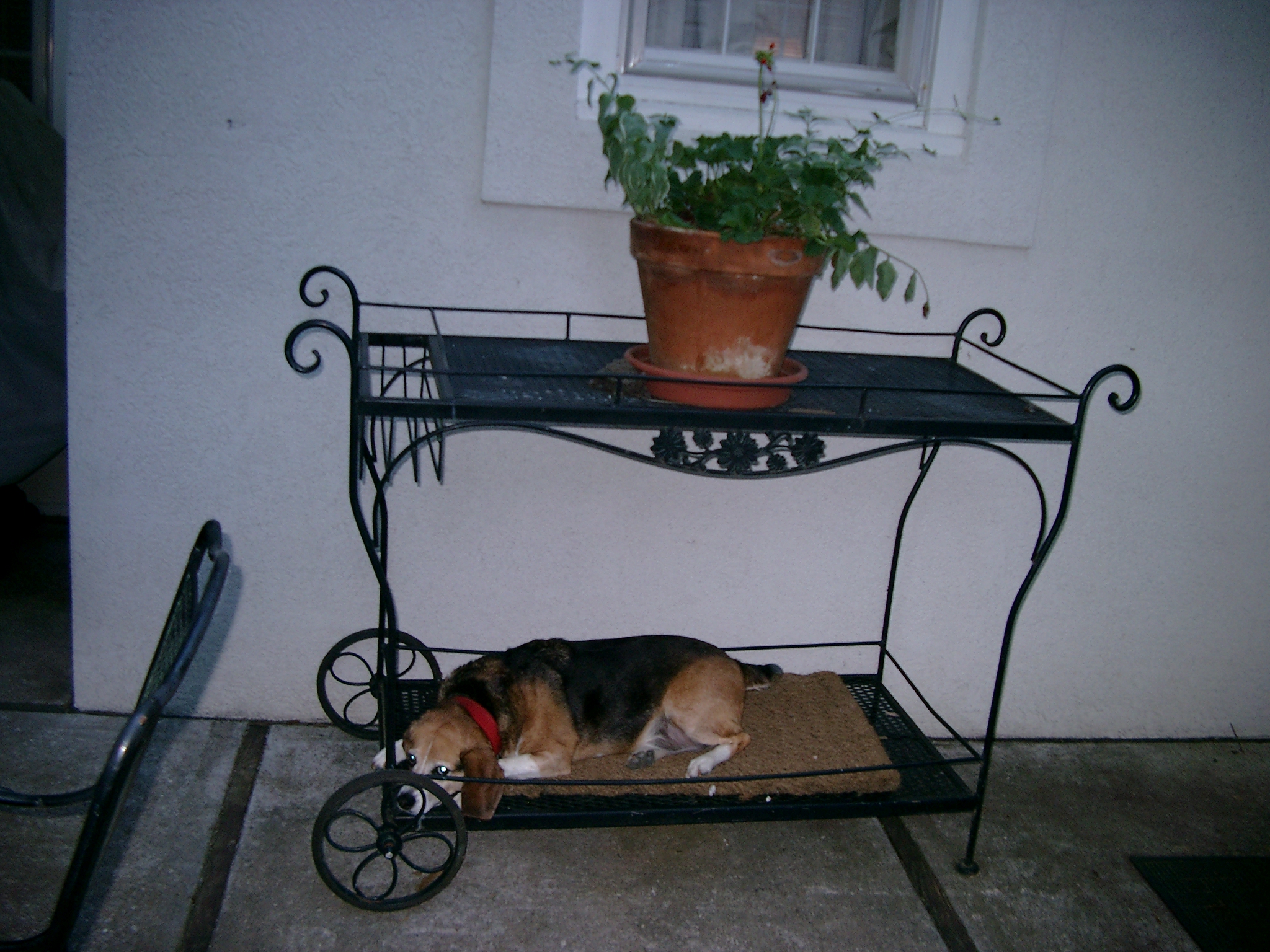
Now here’s a dog in his “comfort zone!”
Are you in your zone? What is meant by “your zone?” I think when someone asks you if you are in your zone, they are talking about your “comfort zone.” This is a state of being in which your anxiety is neutral; a place that you feel very comfortable to be in.

Does Iraq have any comfort zones?
Considering your zone to be a comfort zone, is it growing or shrinking? I think we are all striving to be in some kind of comfort zone as much as possible. We, of course, would like for our comfort zone to be growing. We would like for the activities that we are comfortable doing, to be all of the activities we do. Wow, wouldn’t that be nice? Nice, but not realistic. Therefore, realistically, we should keep trying to have our comfort zone growing.
But, a comfort zone can also “exist” in the mind. We have concepts and ideas about where we belong, how we should behave, how we should live, what we need, when we should be happy, etc. This, in our mind, becomes a mental area that we consider to be part of our comfort zone. I think we should be very careful about this mental part of our comfort zone. You see, this zone is somewhat deceiving.
A comfort zone should feel safe and, for lack of a better word, comfortable. In our minds, the comfort zone can often be a barrier to our thinking. It can cause us to be closed-minded. Consider an example of a person who thinks he should live like his friend lives. Suppose his friend lives without saving for the future and doesn’t live up to his responsibilities. The person can have a comfort zone in his mind that allows her/him to justify a life without saving for the future and not living up to responsibilities. The comfort zone, in this case, is really more of an act of burying one’s head in the sand than being in a zone that gives real comfort.

Comfort zone?
This comfort zone that exists in the mind, has the potential of keeping us from getting what we want most. When we stay inside our safe and comfortable mental zone, we often limit ourselves to the status quo. If we go outside of the mental comfort zone on a somewhat regular basis, we can naturally overcome any fear we may have due to the unfamiliarity of being outside the “zone.” Usually, venturing outside the mental comfort zone has little negative effect. It’s more about making creative and positive use of our imagination. It’s similar to forming a hypothesis in scientific thinking or “what-ifing” in problem solving. I think it reflects why the human mind is so powerful.
Our mental comfort zone, ideally, will expand. It’s up to us to see that it does. The only way it can expand is for us to allow it to do so. It is easy for us to accept the status quo and not venture outside of our mental comfort zone. When we do that, the zone is not expanding and basically, we are not mentally growing. In other words, when our mental comfort zone is expanding, our mind is growing. Learning something new will usually require an expanding mental comfort zone and therefore, a growing mind. Wow!

Not a comfort zone for cows! :-)
Too many people reach a place in their lives where they continuously justify why it’s better for them to stay the way they are, instead of leaving their current comfort zones and allowing them to expand/grow. So, what should we do? Get out of our seats, move and do something (physically and mentally). Do what we need to do and leave the fear in the old “comfort zone.” Truly, F. D. Roosevelt’s quote of, “The only thing we have to fear is fear itself,” can be applied directly to the act of expanding our comfort zones.
We simply, must do what we need to do in order to expand a part of our life that must always expand in order for us to have the best life possible.
Simple to state, yes! Simple to do, Probably not! But like living, we must do it in order to live the life worth living.
What is your comfort zone like?

What Makes A Good Role Model?
Posted on July 22, 2010 Leave a Comment

Are these ladies with their role model? Oh, Andy! :-)
What makes a good role model? That, of course, is the question I asked in the title. I think it is a really difficult question. Often times, the answer depends upon the same thing that beauty depends on – “it’s in the eyes of the beholder.” :-) At least, as I begin this writing for learning exercise, that is the only reasonable statement I can make.

Albert Pujols
Consider some of our celebrated athletes like Albert Pujols, Sarena Williams, Tiger Woods, Marion Jones, Brett Favre, Cheryl Miller, LeBron James, Danica Patrick and Rafael Nadal. Six out of nine of the athletes, listed in the previous sentence, have their own websites dedicated to promoting themselves. Should we use their websites to determine if they are good role models? I wonder why I couldn’t find a website dedicated to promoting Albert Pujols. Oh, there are many sites about Pujols, but none are dedicated to promoting him as a great baseball player AND with him in control of what’s on the site. At least, I couldn’t find any. Why do some promote themselves and others do not?
Does a good role model need to promote her/himself? Ideally, I would answer NO! Of course, ideally isn’t always reality. I don’t think there’s anything necessarily wrong with someone promoting her/himself. It just seems to me that if you are worthy of being a role model, you wouldn’t, or at least shouldn’t, have to promote yourself.
You see, I think good role models live in ways that help us see the way(s) we would like to live our lives. They serve as mental images of how we would like and/or want to be. A website can help, but I think a better role model is one who you can actually interact with. Someone who you can ask questions and observe, in person, the way to live a good life. Someone who can show you actual possibilities for living your life.

Is Peter Pan a good role model?
A good role model is usually a friend, parent, grandparent, teacher, minister, etc. – a good model that can have a powerful and regular impact on your daily life. Now, I realize that some will say that a well-known athlete is a good role model. I’m sure there are a few young and good athletes that have used the role model of a well-known athlete in a positive manner. Though that may be true for a few, I think most of us are better off choosing our role models such that we can interact with them and they can show us good possibilities for ourselves.
Finally, I think it’s important for the role model to first “walk the walk” and then, reinforce it with “talk the talk.” Most children will learn a lot more from what the role model does, than from what s/he says. According to Wiktionary, the term role model means, any “person who serves as an example, whose behaviour is emulated by others”. As you can see, a role model is about behavior. The children need good role models that manifest good behavior. The good behavior needs to be the “walk the walk.” After that has been demonstrated and established, then it can be reinforced with some “talk the talk.”

Stop! Maybe I would be a good role model!
What makes a good role model? A person who can have a powerful, regular impact on daily life AND manifests good behavior that can be emulated. Or, a person who regularly walks the good walk, then talks the good talk, AND does so powerfully!
How about a comment about role models? You can “write the right!” :-)
Character! Is That Who You Are?
Posted on July 19, 2010 1 Comment

Now, here’s a most interesting character!
Recently I wrote a post entitled, “Really, Who Are You?“ In that post, I talked about how difficult it is to really know who we are. The problems of constantly changing and using a “snapshot” for description are a couple of examples why this is such a difficult question. For this post, I will explore an important attribute that each of us can use to help us find out who we are.

Here’s a “darth” character. :-)
When I’m asked to write a recommendation for someone who is applying for a job, school or any other position that requires my opinion of the applicant, the first thing I think about is her/his character. It seems to me that when recommending someone to any position, information about her/his character should be included. Especially, if accuracy and honesty are desired by the person(s) who wanted/required the recommendation. But, what do we mean when we refer to character? On Dictionary.com, the first eight definitions for the noun, character, are:
1. the aggregate of features and traits that form the individual nature of some person or thing.
2. one such feature or trait; characteristic.
3. moral or ethical quality: a man of fine, honorable character.
4. qualities of honesty, courage, or the like; integrity: It takes character to face up to a bully.
5. reputation: a stain on one’s character.
6. good repute.
7. an account of the qualities or peculiarities of a person or thing.
8. a person, esp. with reference to behavior or personality: a suspicious character.

Here’s a character representation of love.
After reading and pondering the eight definitions I listed for character, consider the following quote: “This is that which we call Character,—a reserved force which acts directly by presence, and without means.” Ralph Waldo Emerson (1803–1882), U.S. essayist, poet, philosopher. “Character,” Essays, Second Series (1844).
The Emerson quote seems to sum it up for me. Character, is a force, that from my point of view, is usually off to the side, truly does acts directly by presence, and apparently, without means. Leave it to a poet to “hit the nail on the head!” :-) In June of 2001, Martha Beck wrote an article for O, The Oprah Magazine, where she posed the question, Who Are You Really?
CNN.Com put Ms. Beck’s article on their website in April of 2008. The article discussed the need to let go of labels and even offered a three-step process for accomplishing it. Here they are, and in my opinion, are easy enough to understand:
Step 1. Be Still,
Step 2. Become The Experiencer, Not The Experience, and
Step 3. Practice Truth In Labeling.
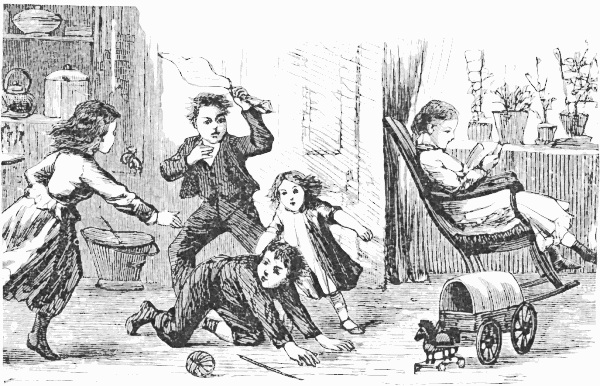
Look at these characters!
If you go to the CNN site, you will be able to read with more specificity, but I think you can understand the point being made by simply reading the steps. In case you choose not to go to read the whole article, here are some excerpts from what Ms. Beck wrote about each step:
Step 1: “If you can do this (Be Still) — get used to sitting still until you feel what you feel and know what you know — your labels will start peeling away like onion skins.” So, be still and think about the label(s).
The first sentence of the explanation for Step 2: “All great wisdom traditions point to the knowledge that the essence of our true selves is not any fixed label but the capacity to experience.”
And finally, the last sentence for the explanation of Step 3 summarizes it all with the following statement: “When the bad labels come at you glue-side up, or the positive ones are stripped away, remember to answer poet William Stafford’s simple question: ‘Who are you really, wanderer?’ Why not remember today?” Label it truthfully!

So, who is this character?
Ok, so “who you are?” and character appear to be directly connected. How do we know when someone has good character? What evidence makes it evident? Considering the various definitions listed above, we should consider the traits and/or qualities of honesty, kindness, enthusiasm, empathy, perseverance, fair-mindedness, etc. and upon observing the evidence of those, determine the person’s character. And how are those traits and/or qualities demonstrated? I think through the behavior and whether or not the person is demonstrating them even when no one is looking. This is important! Character is honestly demonstrated when no one is watching. True character is demonstrated as a trait or quality of a person that is second nature – an automatic way of behaving.
What kind of character are you? Who are you? :-)
Do You Think These Are Truths For Mature Humans?
Posted on July 15, 2010 Leave a Comment
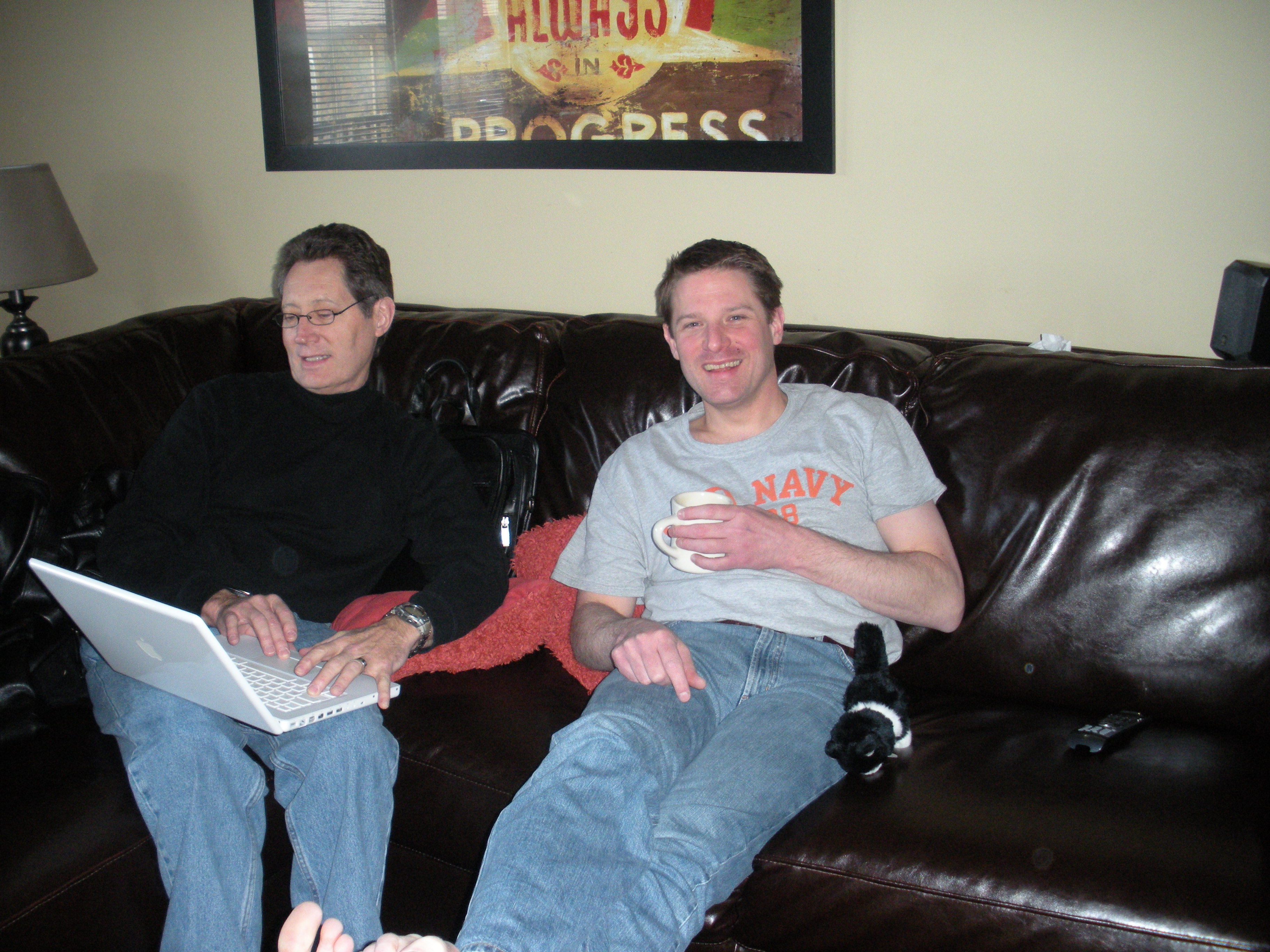
“Out of friendship, should we erase the history on/of this computer?”
Recently, I received an e-mail entitled: “Truths For Mature Humans.” It contained a list of thirty statements, each supposedly an insightful and sometimes funny “truth” for an older and mature human. For example, the first truth was, “I think part of a best friend’s job should be to immediately clear your computer history if you die.” Now, I’m not so sure that’s a truth that I agree with. Perhaps, my best friend’s job should be to clear the computer history when s/he knows that I’m about to be investigated AND what’s on my computer would not help the investigation. :-) Why after death?
Ok, I can imagine there might be some things on the computer that could be negative toward the survivors, but as a general rule, I don’t think a best friend should clear the computer history. Especially, if clearing the history is being done only for me. I’m dead – how can computer history affect me?
For the rest of this post I will list some of what I think are the most interesting or funny truths along with a comment or two from my point of view.
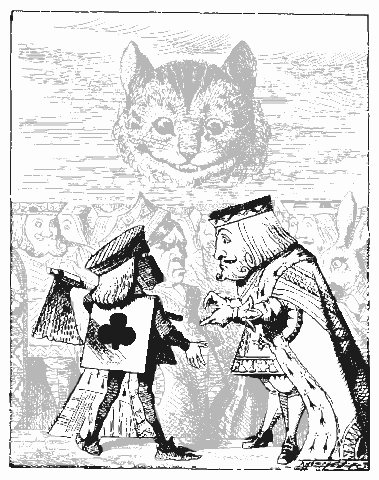
Arguing about cutting off the cheshire cat’s head – Oh, I must be wrong, I can’t cut off a head that disappears!
Nothing sucks more than that moment during an argument when you realize you’re wrong. I think I understand the point here, but really, shouldn’t we try to end the argument. To me an argument is a negative and should be avoided. Therefore, when we know we are wrong, admit it, end the argument and move on.
I totally take back all those times I didn’t want to nap when I was younger. I completely agree with this statement. When the body needs a nap OR should have a nap, give it the nap for “well-being sake!”
I can’t remember the last time I wasn’t at least kind of tired. This seems to be true as I age. On the other hand, I also remember feeling tired a lot during all other phases of my life. The more I think about it, I think this statement doesn’t apply. As I type this I don’t feel tired at all and therefore, I can remember when I didn’t feel at least kind of tired. :-)

A sarcastic gas pump?
There is great need for a sarcastic font. Not a bad idea, considering sarcasm is a form of “humor” that always has a victim. At least, if we had a sarcasm font, then it would be clear when the writer was victimizing. :-)
How in the world are you supposed to fold a fitted sheet? Good question! I usually wash the sheets in our house and I have often wondered if there is a way to fold the fitted sheet that leaves it uniformly thick.
Was learning cursive really necessary? For me, no! The only time I have used cursive, since high school, is to write my name in signature form.

Was this necessary?
I wish Google Maps had an “Avoid Ghetto” routing option. This also applies to the GPS system in my car. On more than one occasion, it has taken me through a ghetto and later on I find out that the only advantage of taking the route was saving a short distance of less than a mile.
I’m always slightly terrified when I exit out of Word and it asks me if I want to save any changes to my ten-page technical report that I swear I did not make any changes to. This applies to many other software programs. It also occurs while I’m blogging using WordPress. When the software program asks me if I want to save any changes and I didn’t make any, I am faced with a logical dilemma. If I save it and I accidentally typed something that I wasn’t aware of, nor wanted, then my document isn’t correct. But, if I don’t save it and I forgot that I made an important change, then my document isn’t correct. Ouch!

I look, but I don’t remember or know what time it is!
Sometimes I’ll look down at my watch 3 consecutive times and still not know what time it is. Maybe this has something to do with age OR does it have to do with not being present in the present? :-)
There’s no worse feeling than that millisecond you’re sure you are going to die after leaning your chair back a little too far. When I read this, I immediately had this weird feeling of weakness and helplessness. Of course, I can have this feeling in other weak and/or helpless situations, but I so understand that this is a feeling that we all can have. Can have, BUT try to avoid, I hope!

I hate pedestrians, I want them in my cab!
Ok, enough of this. I think you get the point and I really don’t have much to say about the other “truths” that were mentioned. Maybe you are wondering what other “truths” I looked at and didn’t include.
Here are three examples:
1) “You never know when it will strike, but there comes a moment at work when you know that you just aren’t going to do anything productive for the rest of the day,”
2) “I hate leaving my house confident and looking good and then not seeing anyone of importance the entire day. What a waste.“, and
3) “As a driver I hate pedestrians, and as a pedestrian I hate drivers, but no matter what the mode of transportation, I always hate bicyclists.“

Is this what is meant by “PC?” :-)
Perhaps, you can understand why I didn’t include the others. I’m hoping you can see what I consider inappropriate with the three examples in the previous paragraph. Of course, you might consider them to be NOT PC (political correct) and that might be enough to discount them. But, even if you don’t “weigh” them using political correctness as your standard, consider the message they are delivering. Not good, from my point of view. Simple as that!
Are these truths for “mature humans?” Well, I think the ones I put in bold are candidates. In my opinion, the others, I only gave three examples, don’t qualify as truths worth classifying as truths! :-)
Why Ask?
Posted on July 12, 2010 3 Comments

Why ask? How’s that for a short question? I was thinking recently about how much I’ve used the statement: “Questions drive thinking and answers end thinking.” For the past twenty-five years that statement has been used by me more times than I can remember – probably, many would say I’ve used it too much. When I was teaching, it was common for me to say it on a daily basis to my students. Upon reflection, I’m sure the students were often tired of hearing it.
 Ok, let’s consider why many of us don’t ask for what we want and/or need. I suppose many of us have been taught, as small children, to not ask. I know, as I reflect on my own childhood, my parents would often criticize me for asking. They would criticize not only questions asked to them, but especially questions that I asked other adults. I think some parents encourage their children not to ask questions to adults because they don’t want their children to be disrespectful and/or aggravating. I suppose there is some merit to that line of thinking.
But, couldn’t (or shouldn’t) we consider the “act-of-asking” as a necessary tool for life? How many people value asking? When we are not having to deal with raising children and we are simply relating to fellows adults, why not ask? I’m not talking about a rude, disrespectful, whining, inconsiderate, and/or unnecessary request. No, I’m talking about a courteous, respectful, considerate, and/or necessary request. Tony Robbin’s former employer, Jim Rohn, once said: “Asking is the beginning of receiving.” There’s a lot of truth in that statement. Generally, if you’re going to receive something, asking, in some form or another, is involved.

Why ask?
Earlier, I mentioned that my parents had criticized me for asking questions. I was in elementary school during the fifties and in high school/college during the sixties. A Canadian woman, Buffy Sainte-Marie, who was a member of the Canadian First Nations and five years older than I am, has often been quoted as proclaiming: “By looking at the questions the kids are asking, we learn the scope of what needs to be done.” After going to high school and college in the sixties, teaching high school for thirty years and raising two children, I think there’s a lot of truth to Ms. Sainte-Marie’s statement. When I look back on my own questions as a kid, and consider all of the kid’s questions I’ve been asked over the years, what needs to be done is generally driven by the questions the kid’s ask.
From another point of view, consider Robert Heller’s mantra of, “Effective management always means asking the right questions.” Of course, you can’t ask the right questions unless you ASK questions. It’s important to not be fooled into thinking that you shouldn’t ask questions.
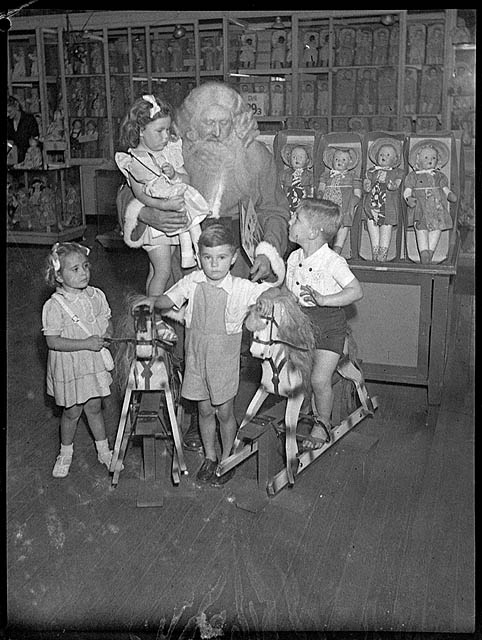
Why ask Santa?
As a child, I thing more than anything, my parents were not prepared to answer the questions I was asking. At the time, I usually stopped when I was criticized for asking questions, but I now think a better approach would have been to keep asking. I should have continued asking, even if I was criticized for doing so. Asking is one of the most powerful paths a person can take for success! It also helps a person to be happier. There is a sense of fulfillment when I have asked all questions I think are appropriate, even if none of my questions were answered. I feel like I know I tried by best. Wow – “I feel like I know I tried” – what a sequence of words! :-)

Does asking = learning?
I realize that asking can sometimes make a person look and/or feel like a fool. And, I also realize that not asking can be an approach that allows one to not take the risk of “looking like a fool.” But, when you view the act of asking from the perspective of the person being asked, you often find that it creates value for that person. Just by nature of asking a question, you give the person implied respect. When we want to know an answer to a question, we normally don’t ask someone we think is not capable of answering it.
Consider an example of a person walking into a room full of people and seeking an answer to a question. How does the person decide who to ask. Perhaps the most friendly looking person or a person who appears to be in a leadership role or a mature looking adult or … Is s/he going to ask a person who s/he thinks will not give a reasonable (correct) answer? Usually not! The point is that being asked a question can be a sign of respectfulness afforded by the questioner. This reminds me of a quote from Thomas Berger (author of Little Big Man and many other books): “The art and science of asking questions is the source of all knowledge.”
Why ask? To learn! Why learn? Oh, c’mon, shouldn’t we always learn? Here is an old Danish proverb that shames us into asking: “He who is afraid of asking is ashamed of learning.” Why ask? :-)
So, I ask, what are your thoughts about asking?
Really, Who Are You?
Posted on July 8, 2010 Leave a Comment

Really, who are you?
The real you is __?__. I don’t know about you, but I can’t give a definitive answer to that fill-in-the-blank statement. I just can’t hit the proverbial “nail on the head” when I’m asked to explain the real me. Why?
And, before I go any further, No, No,… I will not be referring to the famous Who song, “Who Are You?”
I know, I know, the words are pouring out of our minds. We almost sound like owls. :-)
Who, who, who, who?
Who are you?
Who, who, who, who?
Who are you?
Who, who, who, who?
Who are you?
Who, who, who, who?
But, at the end of this post, I will be quoting some lyrics of another famous song. Read on and think about who you really are.

Really, who am I?
I think many of us have a problem when we are asked to explain who we really are. We have many images of ourselves. I know when I look at a picture of myself, I immediately think about whether or not it really reflects what I think I look like. How many of us look at a personal picture taken many years ago and say something like, “I can’t believe I ever looked like that?” Or perhaps, someone tells a story involving you and you think, “I don’t believe that is the way I was then.”
The point is that we often have a difficult time knowing who we really are. Of course, pictures and stories about us are not the same as the real thing. We are always changing and never can we take a snapshot of ourselves and expect that to be who we really are.
But, there is a part of us that continuously tries to hold on to what we think we are. It’s that egocentric part of our thinking that places us at the center of the universe and considers us to know who we always are. It’s the thinking that says, “The only thing I know for sure is me!” But, how can this be? Consider what this kind of thinking really means for you.
When your ego is in control, you tell yourself to keep on trying and if you aren’t getting what you want, then just try harder. You say things like the quote from the Apollo 13 movie, “Failure is not an option.” Often, our egos will turn our lives into catchphrases, in which some become mantras. Take for example phrases like, “That’s just the way I am.” or “I’m too old to do …”. I have heard people make statements like, “Just so s/he is happy.” and “You should always follow your dreams.” These statements, though not necessarily bad statements, are generally unrealistic.

Well, who am I?
Let’s look more closely at some of the catchphrases previously mentioned and consider what is unrealistic about them. “You should always follow your dreams.” Suppose your dream is to become a President of the United States. Well, we have had forty-four presidents. As of today the estimated population of the United States is 310,000,000.What are the chances of any citizen being president?
Or, consider the catchphrase from the Apollo 13 movie, “Failure is not an option.“ I suppose that phrase implies that success is the only option. So what should we do when we fail? And, we will fail, sometimes!
It’s seems to me that we should strive for success, but always be prepared to deal with failures. I believe there isn’t one human being who hasn’t failed!
So, who are you, really? Do you always follow your dreams? If so, then, if your dream is not working out, shouldn’t you change your dream to fit reality. Even when a dream becomes reality, it is temporary. The same is true for success. They are only temporary states of being.
Who do you know that has her/his world filled with only dreams and/or successes? The only thing our world is filled with is reality! I think we are much more likely to have a fulfilling life by making our thinking fit reality, instead of trying to make reality fit our thinking.

I am the court jester, I said!
So again, really, who are you? I don’t think you can ever say who you really are. You are always changing. Trying to say who you really are is like using a snapshot of yourself to say what you really look like. Oh, I know the snapshot will give a representation of you, but it will never display what you REALLY look like. The snapshot is only a two-dimensional picture of you frozen in time. You are not frozen in time and really do look different from the snapshot.
I have asked many times in this post the question: “Who are you?” You might be interested in how I would answer the question: “Who am I?”
When I first started this blog, in December of 2008, I was faced with that question. I wanted the About Me page to reflect the answer to that question. Wow, what a difficult question to answer! Well, I answered it, and my response appears on the About R2 page which has a special tab at the top of all my posts. Click here to read it. If you do, you will notice a “play” on the lyrics to the ♦Neil Diamond song, “I am … I Said”.♦ To hear Neil Diamond sing the song, click here.
Here’s an lyrical excerpt from “I am … I Said,” to get your thinking started AND keep it going! Enjoy!
♢Did you ever read about a frog who dreamed of bein’ a king
And then became one
Well except for the names and a few other changes If you talk about me,
the story’s the same one
But I got an emptiness deep inside And I’ve tried,
but it won’t let me go
And I’m not a man who likes to swear
But I never cared for the sound of being alone
“I am,” I said
To no one there
And no one heard at all
Not even the chair
“I am,” I cried
“I am,” said I
And I am lost,
and I can’t even say why
Leavin’ me lonely still.♢
Really, Is There A “Wine Country” Near St. Louis, Missouri?
Posted on July 5, 2010 4 Comments
 Suppose you like to visit wineries and you are in Saint Louis, Missouri. What’s the possibility of finding a good group of wineries close enough to visit, and then return to St. Louis? And, how about doing this in one afternoon? What’s the possibility? 100%!
Look at the map below this paragraph. The town of Augusta, Missouri is marked with an “A,” located along highway 94 and in the middle of what is now officially called, the Augusta Wine Region. Notice the ruler icon in the lower left-hand corner showing the 5 mile/10 km increments for the map. The Augusta Wine Region is less than an hour drive from almost anywhere in St. Louis. (Note: All maps and most pictures in this posting can be enlarged by simply clicking on them. Your browser will load an enlarged picture in a new window.)

I live in St. Louis and have enjoyed Missouri wineries in this area, now known as the Augusta Wine Region, for over thirty years. When my wife and I started dating, thirty-four years ago, one of our first dates was to Mount Pleasant Winery in Augusta, Missouri. It is the oldest winery in the region. It was established in 1859, and is located in the heart of the Augusta Appellation Wine District. That district is the first in the United States, founded in 1980. For time comparison, Napa Valley, in California, was the second in 1983.
My wife and I spent the afternoon in the Augusta Wine Region on June 29, 2010. I took pictures at each of the nine “wine-stops” between Chandler Hill Winery (beginning) and Blumenhof Winery (end). Some of these pictures are provided for your viewing pleasure and to help give you an idea of what the Augusta Wine Region is like.
The distance from Chandler Hill (labeled “C” on the above map) to Blumenhof (labeled “B” on the above map) is 16 miles. The map below shows you the various wine-stops between them.
When looking at the map below, you can see the relative distances between all of the nine wine-stops that we encountered on June 29. Following the map, is a “hyper-texted” name of each wine-stop and some information that I hope you find interesting and useful. By clicking on the hyper-texted name of each stop (usually a winery), your web browser will open up the website for that particular wine-stop.

The rest of this post is designed to help you have a virtual driving tour of the Augusta Wine Region that my wife and I did on June 29, 2010. The wine-colored car separates each stop, so you will know when we are back on the road. :-)
Again, most pictures can be enlarged, if you click on them.

Our first stop is Chandler Hill Vineyards. On June 29, my wife and I arrived around lunch time and had sandwiches and a glass of wine on their “over-sized” deck.

Chandler Hill is one of the newest AND closest to St. Louis. It opened in 2008 and now features good food with nice facilities for eating – either inside or outside. They charge for tasting and you are not allowed to bring food or drink.
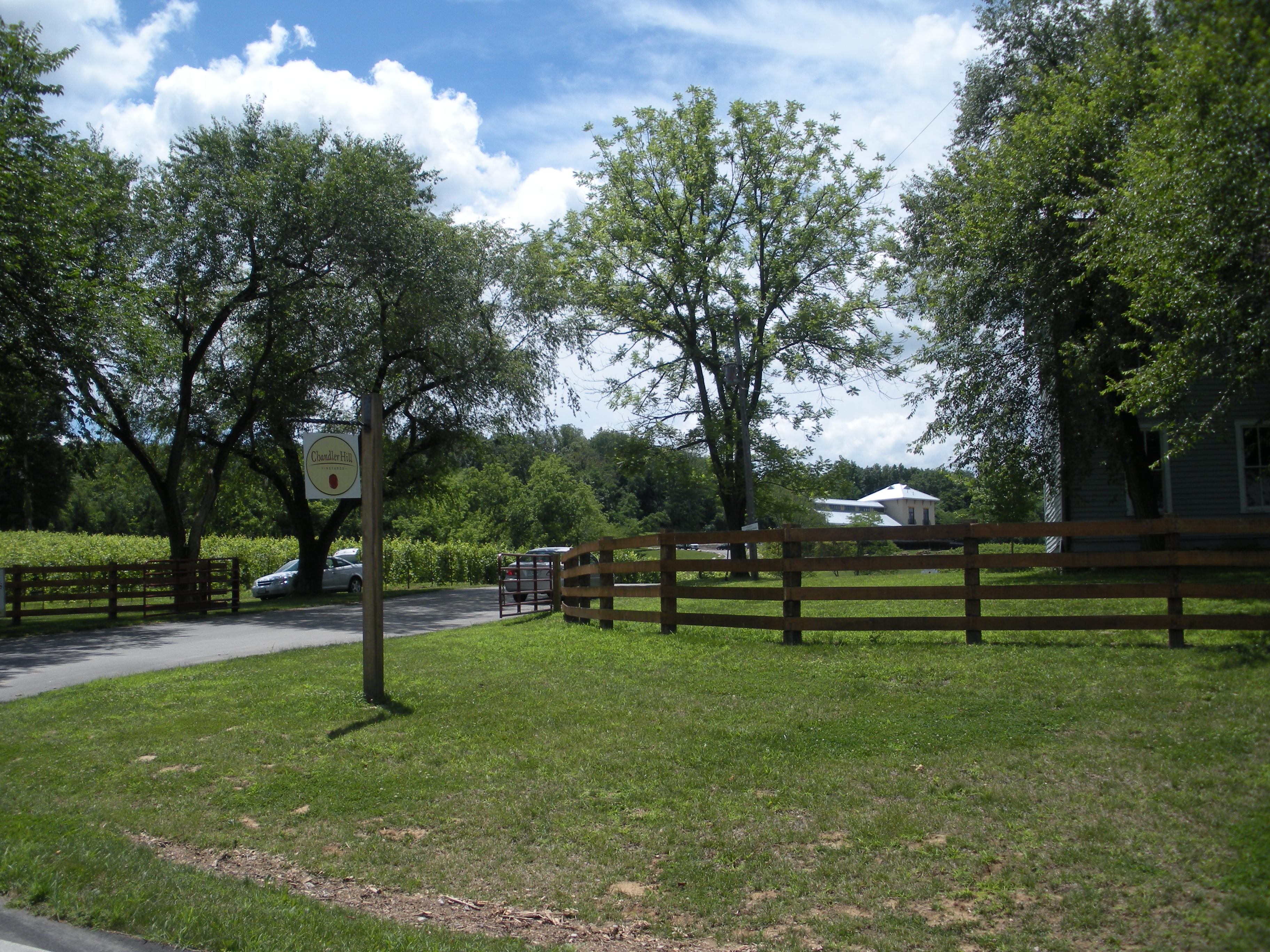
This is the entrance to Chandler Hill as you enter from Defiance Road, near highway F.
Here’s a little history of the land that the winery is on, quoted directly from their website. “In the early 1870s, a former slave traveled north from the Civil War-torn south and settled near Defiance, Missouri. Befriended by a family who lived on property next to that belonging to the family of Daniel Boone the freed man worked on their farm for many years and was married in the 1880s. Eventually, the family deeded him 40 acres of their land including a hill overlooking the beautiful Femme Osage Valley.”

This is the view from Chandler Hill’s extra large deck.
“The man’s name was Joseph Chandler who died in 1952 at the age of 103. Chandler Hill Vineyards operates on the same property he once owned. The tasting room and winery stands on the site of Joseph Chandler’s modest cabin. During excavation for the winery building many century-old artifacts were uncovered including a shotgun, rifle, stove remnants, buttons and china. These storied relics of Joseph Chandler are on display at the winery. The stones from the original cabin foundation were also carefully removed and are being used as a feature at the winery.”
After having lunch, we left Chandler Hill and visited Wine Country Gardens. Until recently, we have been stopping in the Gardens primarily for buying plants. For example, my wife and I have seven beautiful Holly Bushes from Wine Country Gardens that we planted in our yard three years ago. Of course, it was nice to be able to taste wine before buying the bushes. :-)
Because of the nursery, if for no other reason, this stop in wine country is well worth it. This is true, even if you aren’t interested in purchasing plants. In some ways, it’s like a small botanical garden. And, you can taste and purchase wine!

The Wine Country Gardens has been growing each year since 1997. It started out as an overgrown farm and farmhouse and is now a large nursery, restaurant and wine garden. You may buy wine by the glass or bottle, but no Missouri wine is offered. They do not charge for wine tasting.
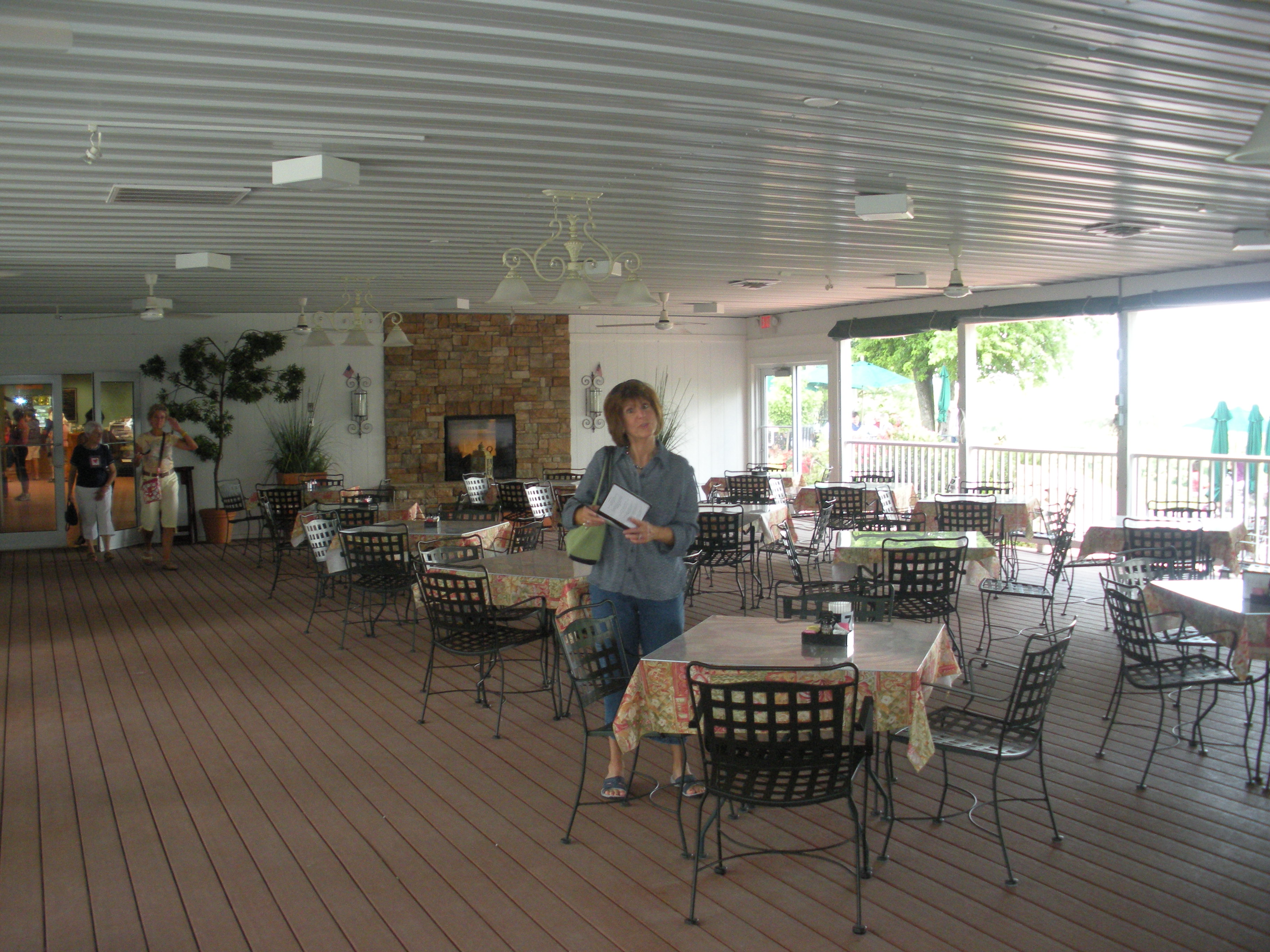
This gives you an idea of how big this facility is. The outdoor seating for the cafe is on the right and the tasting room is behind the wall directly behind the lovely model. Behind the photographer is another large seating area.
Here is a quote directly from their website: “Featured in “Better Homes and Gardens” our 42 acre nursery and farm provides a relaxing country atmosphere while offering a selection of over 80,000 perennials and flowering shrubs. Our lovely century old home over looks the beautiful Missouri River valley and is surrounded by many patios, ponds with waterfalls, swans and ducks, gift shops and display gardens. The Patio Café & Wine Garden is open daily to further enhance your experience.”
On June 29, we weren’t able to visit the Yellow Farmhouse Vineyard and Winery since it was Tuesday and they weren’t open. In the past, when I did visit, I was given a tour by the owner. The winery is small and I would classify it as a “boutique” winery.
Yellow Farmhouse Vineyard and Winery

I have been to the Yellow Farmhouse Winery only once since it opened a few years ago. I usually try to visit the wine country during the week and the Yellow Farmhouse is only open on the weekends. It’s a small winery located in the center of the small town of Defiance, Missouri. When I went, there was a charge for tasting, but the cost was waved if you purchased a bottle or more.
Here is information about the winery, quoted from their website: “Yellow Farmhouse Vineyard & winery began as an idea in the late 1990′s. Dale Rollings, an avid “basement winemaker”, having lived and worked in nearby St Charles for over thirty-five years, had visited the wineries of the Missouri River Valley many times and recognized that the wines made there were improving with each passing harvest. It was well-known that vineyards were flourishing along the Missouri river from Defiance to Hermann, and that Highway 94 was becoming a veritable ‘route du vin’. Each weekend, more and more visitors made the journey to the vineyards and wineries that dotted the hills along the river.”
“In 2003, Dale acquired the first tract of what would become Yellow Farmhouse Vineyard & Winery. It was then a dilapidated bed-and-breakfast, but the hillside was perfect for growing grapes. In the spring of 2005 the first Norton vines were planted. The site proved to be just right.”
As mentioned before, we did not stop in the Yellow Farmhouse, so our next stop was Sugar Creek Winery. We tasted, had a nice visit with Ken, one of the owners and bought a bottle of wine. Ken mentioned that we would have a drink for my birthday, the next time I visited. What a nice and friendly place Sugar Creek Winery is! It consistently provides me with the greatest positive “wine country” experience in the Augusta Wine Region!

Sugar Creek Winery is one of my favorites. My wife and I consider the owners, Ken and Becky Miller, our friends. We have known them since the mid-nineties when they bought and opened Sugar Creek. Tasting is free and picnic baskets are welcomed – all drinks must be purchased at the winery.

Here’s Sugar Creek’s sign along highway 94.
Here is a direct quote from Sugar Creek Winery’s website about their tradition: “Never mind that hilly, wooded area in West Kirkwood Missouri known as Sugar Creek, we’ve found our own version of sweetness on the bluffs of wine country in St. Charles County. We Kirkwood expatriates made our big move to Missouri’s vineyard mountains in 1994. We christened this happy hideaway Sugar Creek Winery, and we continue to have plenty of visitors from our old hometown of Kirkwood and the surrounding environs to keep us company. We really love it here. Every morning we wake up to fantastic scenery and a fascinating and growing business. It’s a business that attracts some really special people – people who are looking to relax and enjoy the product of our vineyards.”

Sugar Creek’s entrance. As you can most likely determine, you drive up a steep hill and are rewarded with spectacular vistas.
I think you can tell, from the previous paragraph, how nice and friendly the ambiance is at the winery.
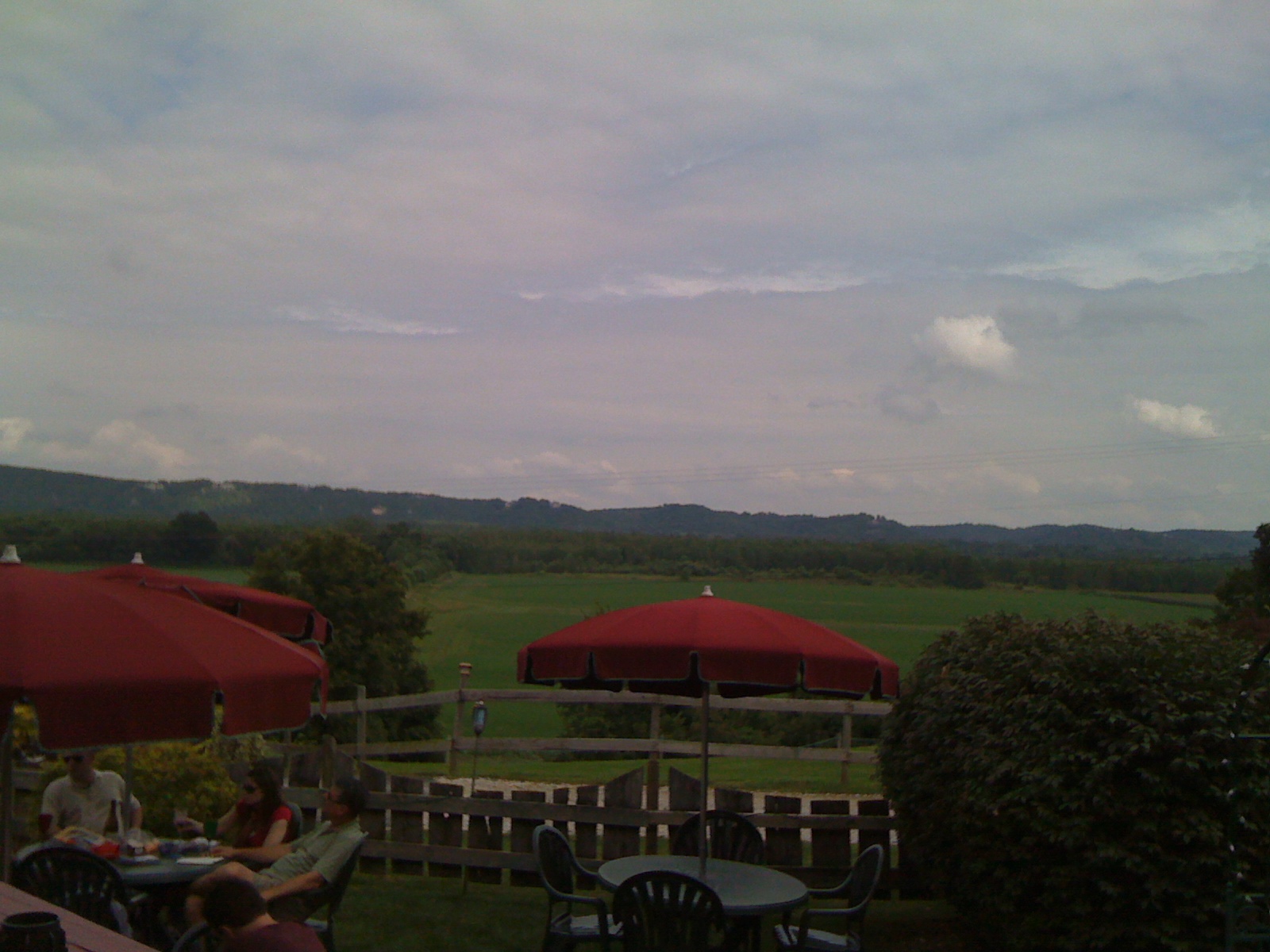
This picture was taken from Sugar Creek’s deck last year. I think it will give you an idea of the view from their deck.
After leaving Sugar Creek, we drove to Montelle Winery. On the way to Montelle, you climb a rather steep hill by a quarry known as Klondike Quarry. The hill is steep and winding and has a couple sharp curves that together was known in the sixties as “dead-man’s curve.” It’s much safer now. :-)

Montelle Winery was one of the first wineries that my wife and I went to in 1976. It was a lot smaller during the 70’s and 80’s, but has always had one of the best scenic views. Tasting is free, but you can’t bring any food or beverage – all must be bought there.
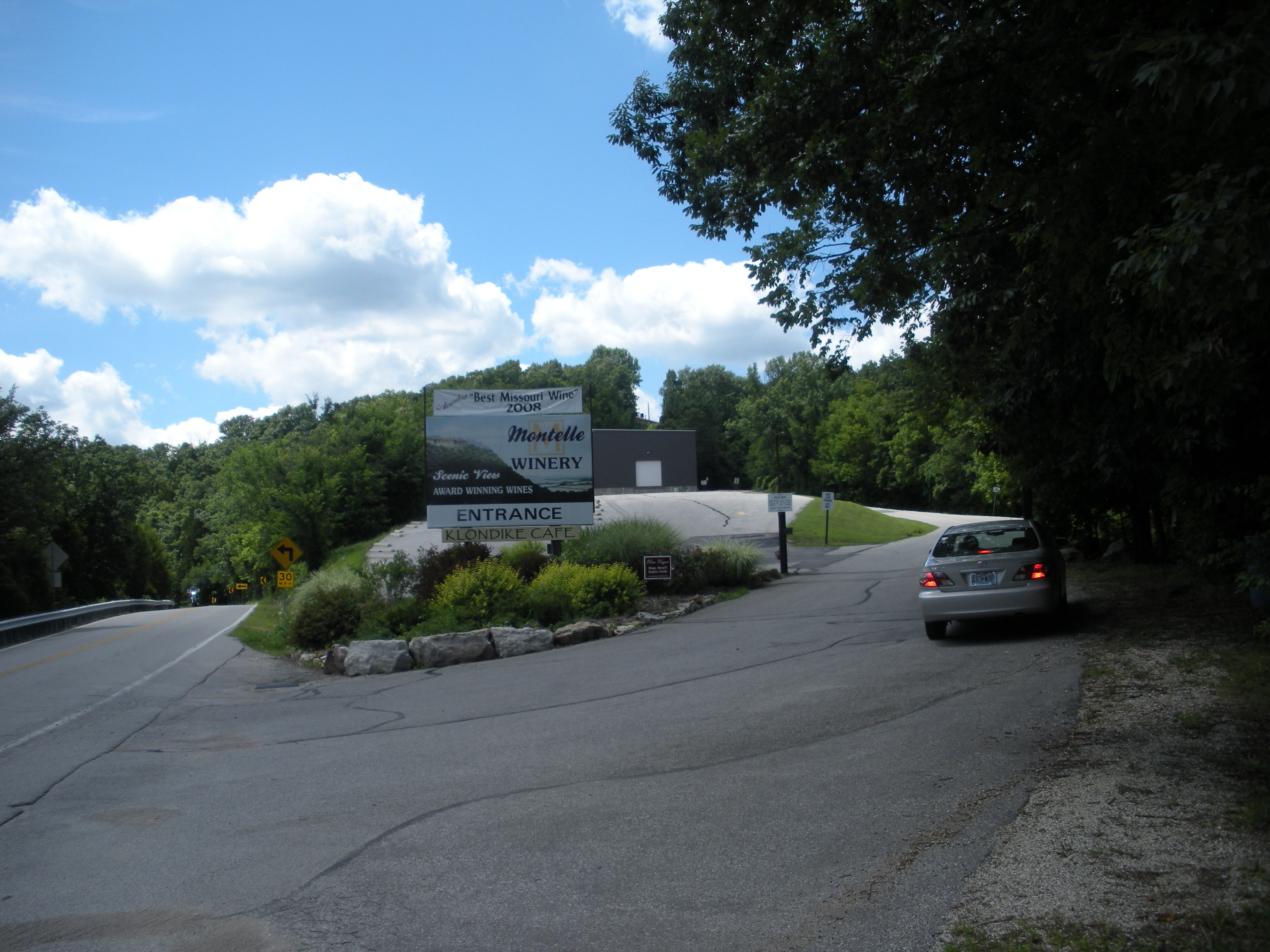
This is the entrance for Montelle Winery from highway 94.
The winery has a long history. Here is a direct quote from the winery’s website: “The Augusta region was nationally known for its wine during the 19th century, but Prohibition halted the state’s winemaking for decades. Then, in the late 1960s and early 1970s, a few pioneering souls began to refurbish the old vineyards and winery buildings. One of these pioneers was Clayton Byers, who founded Montelle Vineyards in 1970. The winery was later purchased in 1998 by present owner and wine maker Tony Kooyumjian.”
“The secret to our success in producing outstanding wines is our vineyards. The Augusta area was chosen as the first viticulture area in the United States because of our unique soils, microclimate, and history, and it is our mission to produce wines that exemplify the uniqueness of this eleven square mile area. Our philosophy is to farm our vineyards with a respect for the land and the environment. As a result, our wines are fresh, fragrant, focused, and well-balanced, but most of all, express the uniqueness of our vineyards. It is this attention to detail that has enabled us to produce wines that are continuously recognized for their uniqueness and superior quality.”

The view from the the deck of Montelle Winery is spectacular!
“In addition to our wines, Montelle is also the first winery in Missouri with a distillery. We produce four kinds of brandy: apple, peach, cherry and grape (grappa).”
The next stop on our wine country tour is Augusta Winery, located in the town of Augusta. It’s a sister winery to Montelle.

Augusta Winery is owned by Tony Kooyumjian, who also owns Montelle Winery. He bought both wineries in 1988. In my opinion, Augusta Winery has good wine and is reasonably priced, especially if you buy bottles to take-home. Tasting is free and they do have a nice outdoor area to sit. Sorry, I have no pictures of their newly expanded outdoor area but the home page on their website does offer some.
Here is a quote from Missouri Wine Country about Augusta Winery: “Augusta Winery makes fine wines in a variety of styles, from dry European to sweet dessert wines, all from vineyards dating back over 100 years. Located in the first federally designated viticulture area in the U.S., Augusta Winery vints its wines in small quantities so special care may be given to each lot. Winner of the Governor’s Cup for Best Missouri Wine in 2004, 2006, & 2007, enjoy a bottle of our award-winning wines with locally produced cheeses and sausages on our wine terrace. The winery also features a tasting room, gift shop, and custom-labeled wine for your special occasions. Come our and enjoy our NEW terrace, the Augusta Wine & Beer Garden! It features a spectacular 10-foot tall grape arbor and a serene water fountain.”
Also, in the town of Augusta, is one of the oldest wineries in the United States, Mount Pleasant Winery. It’s only a block from Augusta Winery, but is much bigger. We could have easily walked from the Augusta Winery to Mt. Pleasant Winery.
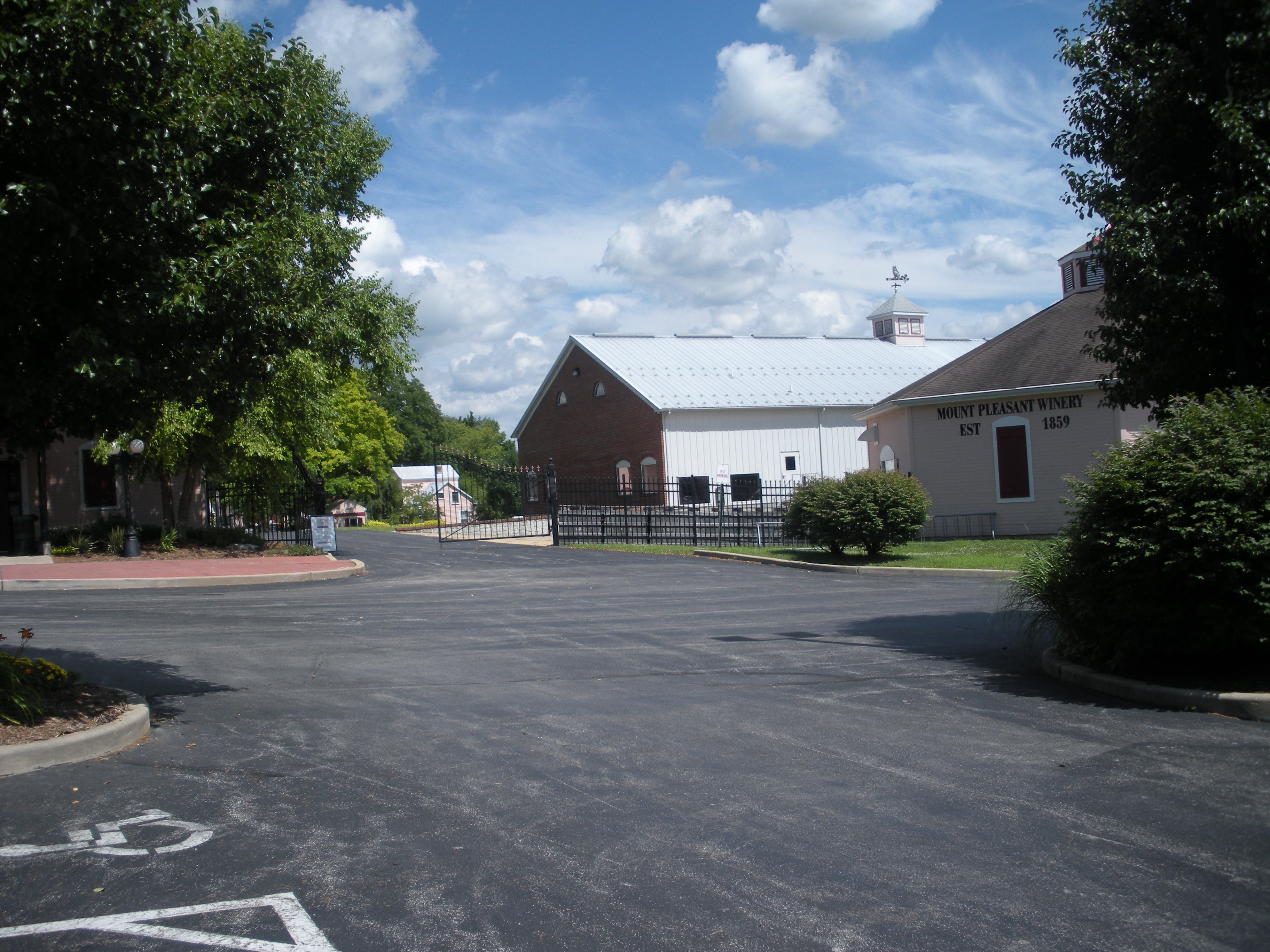
Mt. Pleasant was the first winery that my wife and I visited over thirty years ago. As mentioned before, one of our first dates was at this winery. It has grown to over ten times the size it was in the 70’s. They charge for tasting and do not allow any outside food or beverages.
This is a current picture of the patio at Mt. Pleasant Winery where we shared that first “wine date” and a bottle of wine, thirty-fours years ago.

Mt. Pleasant’s outdoor seating area that my wife and I shared that “first wine date bottle of wine.”
Here is a direct quote about the history of Mt. Pleasant from their website: “Mount Pleasant Winery was founded in 1859 in Augusta, Missouri; America’s first designated wine district. George Munch, who came with his brother, Frederick, from Germany, established a vineyard and winery in an area that reminded him of his homeland. From the beauty of the topography to the incredible potential for creating excellent wines, they chose Mount Pleasant. The original cellars were completed in 1881 and were built from the wood and abundant limestone in the area.”
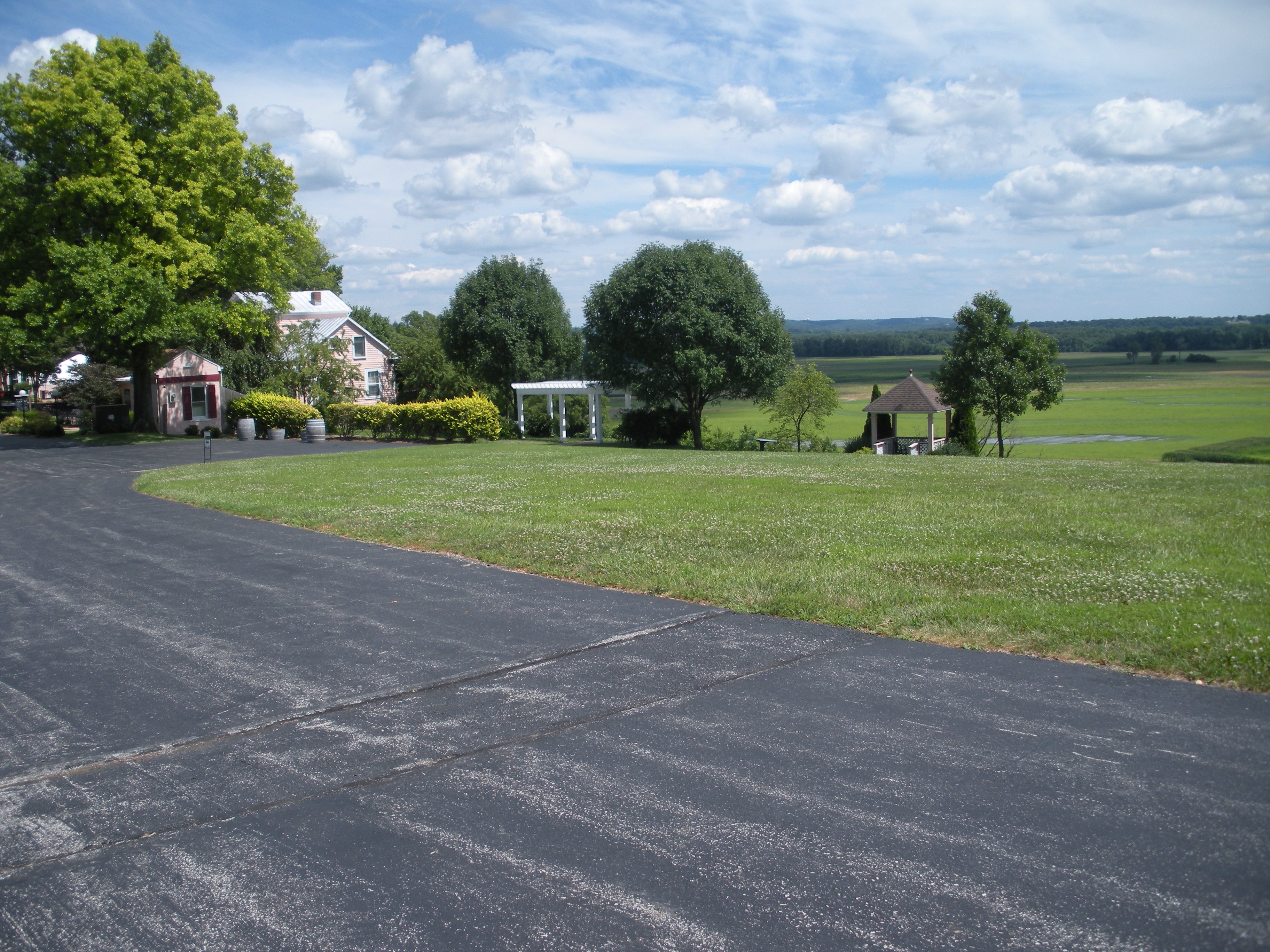
This picture shows some of the buildings and a little of the view when sitting out in Mt. Pleasant’s terrace.
“When Prohibition hit in 1920 the winery was forced to close and all of the vines were removed. In 1966, the winery was reopened and the vineyards were replanted with self-rooted vines and classic grafted European varieties.”
“In 1980, the Augusta Appellation was created and became America’s First Wine District.”
“Today, the winery grows 16 grape varieties on 85 acres and the original cellars are still used to age the “estate bottled” wines and our international award-winning Augusta Ports.”
After Mount Pleasant and the town of Augusta, our tour continued along highway 94 to Louis P. Balducci Vineyards. We usually refer to it as just, “Balducci’s.”

Louis P. Balducci Vineyards is another of my favorite wineries, not only for the wine, food and scenery, but also because I met my wife at Balducci’s Winefest restaurant in West St. Louis County in 1976. This was long before the winery was open, but one of the owners of the winery (Rick Balducci), also is an owner and founder of the West St. Louis County restaurant. Tasting at the winery is free and you may bring your own food, but they do have some of the best food for sale in the Augusta Wine Region.

The entrance to Balducci’s from highway 94.
Here is a direct quote from the winery’s website that illustrates how welcome you are made to feel when you visit.
“Welcome to Louis P. Balducci Vineyards and Winery, Experience the sights, sounds and tastes of rustic Italia!”
“Nestled on 76 acres in the rolling hills of Augusta, Missouri, you’ll find Louis P. Balducci Vineyards and Winery. Family owned and operated since 1987, the 100 year-old farm and vineyard is situated on picturesque grounds that offer a truly relaxing atmosphere like no other.”

This picture was taken last Fall and shows the view from the back of the tasting room at Balducci’s.
“Come sip our premium Missouri wines or select beers, dine on sumptuous, award-winning food from selected family recipes, or simply “go casual” and bring a blanket & your own picnic basket to enjoy on our spacious grounds. You’ll take delight in the sounds of the very best music our area has to offer. And your experience is complemented by a second-to-none staff that makes you feel like famiglia! (family)”
And, now we are at the last winery on our tour of the Augusta Wine Region – Blumenhof Vineyards. As mentioned earlier, we had a glass of wine at the first winery, Chandler Hill. After that glass, we only tasted at the other wineries. Before we left St. Louis for our visit to wine country, we had arranged to meet my sister at Blumenhof. She lives relatively close to Dutzow, Missouri, where Blumenhof is located. She joined us for a tasting, a bottle of wine and a relaxing good time.

Blumenhof is another winery that I have been going to for over 30 years. It has always had good wine at a reasonable price. The atmosphere is created first, by the chalet style of the winery and second, by the strong German theme. In fact, I have been there, more than once, when they had for entertainment an “OOM-PA-PA” group (band with a tubist)! Tasting is free and you may bring your own food.

The entrance to Blumenhof from highway 94.
Here is a direct quote from their website: “Blumenhof Winery is located on Highway 94 in the historic village of Dutzow, Missouri’s oldest German settlement, founded in 1832. Blumenhof, which in German means “Court of Flowers” takes its name from the Blumenberg family’s ancestral farm in northwestern Germany. German heritage is also expressed in the winery’s architecture and in the warm friendly ambiance that invites visitors to “stop… and smell the Blumen.”
———-
After the bottle of wine and a long visit with my sister, we drove back to St. Louis. In about an hour, after leaving Blumenhof, we were sitting in our living room and reminiscing about the wonderful afternoon we spent in the Augusta Wine Region. We had comfortably visited seven wineries and one nursery/restaurant which serves wine and looks like a botanical garden, ALL in one afternoon. Of course another winery was closed, but it would have been possible, on the weekend, to have nine wine-stops. Wow!
Well, I hope you enjoyed the tour. In the future, I plan on doing more posts on the Augusta Wine Region. For the next three or four that I do, I will concentrate on some specific characteristics of one or two wineries and hopefully, give you the reader, more of the feel and/or ambiance that I experienced while visiting them.
So, is there a “wine country” near St. Louis, Missouri? I say YES! What do you think?
Is My Old Brain Not As Good As A Young Brain?
Posted on July 1, 2010 2 Comments

This “old brain” seems to be growing! :-)
Are old brains not as good as new brains? In some ways, they may be better!
Brain research has shown that old brains have a better chance than new brains of learning what to consider relevant and then bringing it to the forefront of thinking. New brains tend to consider everything, with little consideration for relevancy. The older and more experienced brain, due to being trained by its experience, filters–out all information from our senses that it thinks is presently unnecessary.
For an example of how this filter works, consider how you process information in a large social gathering where many different groups of people are engaged in many different conversations. You hear the noise of the various conversations, including some music, and still you are able to focus on a specific set of information from your senses. You may hear the music, hear your friend talking, hear the others around you talking, see others, see the musicians, smell perfume, smell food, etc., yet you have no trouble thinking about what you consider relevant. Apparently, the older brain is capable of doing this better than the younger one. Yea, for old brains! :-)
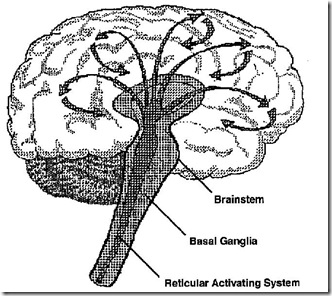
The human brain and location of the “filter.” (RAS)
So, why is it hard to teach older brains? Well, the RAS has either consciously or subconsciously been programmed and acts as a filter for what you focus your thinking on. A younger brain does not have the amount of programming that the older one does. The RAS in the younger brain is not as developed and therefore will consider almost everything brought to it by the senses. Of course, that can be overwhelming. It can also cause “information overload,” where the younger brain is unable to focus on anything relevant to its current task. To use a well-known metaphor, sometimes the younger brain, “can’t see the forest because of the trees.”

If the computer doesn’t already know, then can we tell it?
But, explaining how the RAS affects younger brains doesn’t answer the question, “Why is it hard to teach older brains?” The RAS can be a strength, but it can also weaken the power of the older brain. In fact, I suspect that it is the reason behind Yogi Berra‘s statement: “There are some people, who if they don’t already know, you can’t tell them.”
You see, if an older brain doesn’t know and the RAS is filtering out everything it doesn’t already know, then any new thing received, through the senses, will not be allowed into its conscious. The new information will be filtered-out and discarded. Ouch!
So, it’s important for all of us to realize that as we get older, each brain’s RAS is doing what it is designed to do – filter! Therefore, we need to consciously subject our older brains to new sensual experiences. Actually, they may not be new to us, but maybe just experiences that have been filtered out previously. The key is, understanding that we have such a system and that we are able to change or adjust the filter.
I realize that older brains process more slowly, but maybe that has more to do with how sophisticated our RAS has become and less with age. While the younger brain is quickly responding to all of the sensual information, perhaps the older brain is more thoughtful, careful, considerate and therefore, not making decisions quite as fast. I have read that 60 and 70-year-old brains are producing new neurons at the same rate as brains that are much younger. And, quickness of decisions are usually not as important as quality of decisions!

Is this an old brain or a young brain?
Are old brains as good as new brains? YES! And, especially when the older brain realizes that the RAS is simply a filtering system that does not distinguish between conscious and subconscious messages and/or information. So if the older brain wants to achieve a specific goal, then it must be made prominent in the conscious mind, which in turn, will be passed to the subconscious mind through the RAS. Knowing that we have a RAS and using it as a strength is much better than simply saying that we are too old to learn.
 I have older friends who proclaim that they are too old to learn something new. One of my friends says she can’t learn how to use a new piece of software because she is just too old. From my point of view, she’s a bright person whose RAS filters out all things that involve doing something differently from what she currently knows. The instant that this new learning sensation enters her brain, her RAS filters it out and labels it as something she should ignore. And, that’s what she does. But suppose, she would consciously make a goal to learn how to use the new piece of software? Suppose she restates that goal over and over and over until it is in the forefront of her conscious mind? I think then, the goal would be brought to her subconscious mind and learning how to use the new software would be just a matter of time. The learning of the new software would be like a picture in her house that she looks at regularly. The main difference is this would be a picture in her mind instead of a picture in her house. She will then be an old brain that has learned how to learn something new. Using another metaphor, you may not be able to teach an old dog new tricks, but you can teach an old brain how to learn something new!
Really, what should we all do? Live life, stop wasting life no matter what the age AND check our filters! :-)
What do you think? Is your RAS filtering out something it shouldn’t? Is my old brain not as good as a young brain? For the last question, as long my filter is “cleaned” periodically, the answer is NO! :-)
Will You Still Love Me, Will You Still Feed Me, When I’m Sixty-Four?
Posted on June 28, 2010 5 Comments

When I turned 21, in June of 1967, the Beatles released Sgt. Pepper’s Lonely Hearts Club Band, an album that contained the song When I’m Sixty-Four. I bought the album soon after it was released and immediately liked the entire album, especially the song, When I’m Sixty-four. It was a song that had “catchy” lyrics and a melody that I couldn’t seem to get out of my mind. Click here if you would like to hear a 30 second excerpt from the song.

Paul McCartney – Do you still love him when he’s older than 64?:-)
When I’m Sixty-Four was written by Paul McCartney in 1958 when he was sixteen years old. It was first recorded in December of 1966 and as mentioned above, released in June of 1967. Some think that McCartney thought of the song while looking for material for the album Sgt. Pepper’s Lonely Hearts Club Band because his father had turned sixty-four in 1966. The lyrics were written such that the song is sung by a young man to his lover, and is about his plans of growing old together with her.
The instrumentation is rather unique. A clarinet trio (two B-flat soprano clarinets and a bass clarinet) is featured prominently in the song, unusual in most music genres, but particularly in the context of rock and roll. Scored by George Martin (the Beatles’ producer), he said they were added at McCartney’s request to “get around the lurking schmaltz factor” by using the clarinets “in a classical way.” In the song’s final verse, the clarinet is played in harmony with McCartney’s vocal: an unusual method of harmonization, especially in 1967. Supporting instruments include the honky-tonk piano, bass, tubular bells and electric guitar.
 Well, you’re probably wondering why, in this post, I’m referring to age and the Beatles’ song, When I’m Sixty-four. On June 29, 2010, I am 64 years old. As mentioned before, I liked the song when it was released. And, I still like it!
Often times, when I was teaching mathematics, the number 64 would, in one way or another, be part of my class. As you most likely know, 64 is a perfect square (64 = 8² and √64 = 8), it’s a power of 2 (64 = 2 raised to the eighth power), it’s the value of the ninth place in the binary numeral system (100000000 ‘base 2’ = 64), etc… The point is, 64 seemed to be a part of my “everyday talk” in class.

“Pure corn from the farm”:-)
Sometimes, when 64 came up in class, I would start humming the tune of When I’m Sixty-four and sing a line or two. I know you are probably saying to yourself, “That’s corny!” You’re correct, if that’s what you think. But, that was the point! Frequently, in order to put a smile on my students’ faces and “lighten-up the class a little,” I would introduce some pure corn from the farm. :-) I called it, “pure corn from the farm” (corny) because, as I would tell my students at the beginning of each school year, I was raised on a Missouri farm and therefore, considered myself a farm boy. So, it’s only appropriate that a Missouri farm boy uses “pure corn from the farm” in his daily life. :-)
And now, let’s end this post with the lyrics to When I’m Sixty-four along with a comment from me after each line. Why am I doing this? Just to have some fun with my birthday and the words to a song that is most appropriate at this time in my life. :-)
When I’m Sixty-four
When I get older losing my hair, (Haven’t lost it all, YET! :-)
Many years from now, (Many years from now is NOW!)
Will you still be sending me a valentine (I hope so, since my love has for the past 33 years)
Birthday greetings bottle of wine? (I hope so AND I do love wine:-)
If I’d been out till quarter to three (Sorry, I can’t stay up that late ;-)
Would you lock the door, (No problem, I have a key :-)
Will you still need me, will you still feed me, (I don’t mean to sound needy, but I hope so)
When I’m sixty-four? (Yea, I am!)
oo oo oo oo oo oo oo oooo (Well, oo, oo, oo, to you too :-)
You’ll be older too, (ah ah ah ah ah) ( Ah yes, every year I get older and SO do you :-)
And if you say the word, (Please, keep saying it)
I could stay with you. (And I will)
I could be handy mending a fuse (I can do that, just did so recently)
When your lights have gone. (I can even change the light bulb :-)
You can knit a sweater by the fireside (No fireside on June 29 in St. Louis – Too Hot !:-)
Sunday mornings go for a ride. (How about a bicycle ride?)
Doing the garden, digging the weeds, (Absolutely – I “dig” weeds :-)
Who could ask for more? (I could, but I won’t :-)
Will you still need me, will you still feed me, (Again, I don’t mean to sound needy, but I hope so:-)
When I’m sixty-four? (Yea, I am!)
Every summer we can rent a cottage (Or a villa, in South Carolina?)
In the Isle of Wight, if it’s not too dear (Actually, Hilton Head Island, to be clear)
We shall scrimp and save (Of course, it’s a by-product of retirement :-)
Grandchildren on your knee (Three out of my five grandchildren are too big to sit on my knee :-)
Vera, Chuck, and Dave (No, their names are Brittany, Brad, Katie, Ella & Evie)
Send me a postcard, drop me a line, (I prefer e-mail :-)
Stating point of view. (“Point of view” is a part of thinking that I really value)
Indicate precisely what you mean to say (“precisely” is an excellent standard of thinking that I value)
Yours sincerely, Wasting Away. (Sincerely, I’m not wasting away, just getting older :-)
Give me your answer, fill in a form (I love communication)
Mine for evermore (I hope so!)
Will you still need me, will you still feed me, (And again, I don’t mean to sound needy, but I truly hope so :-)
When I’m sixty-four? (Yea, I am!)
Whoo! (Well, whoo to you too! :-)
Are You A Teleological Kind Of Person?
Posted on June 24, 2010 Leave a Comment
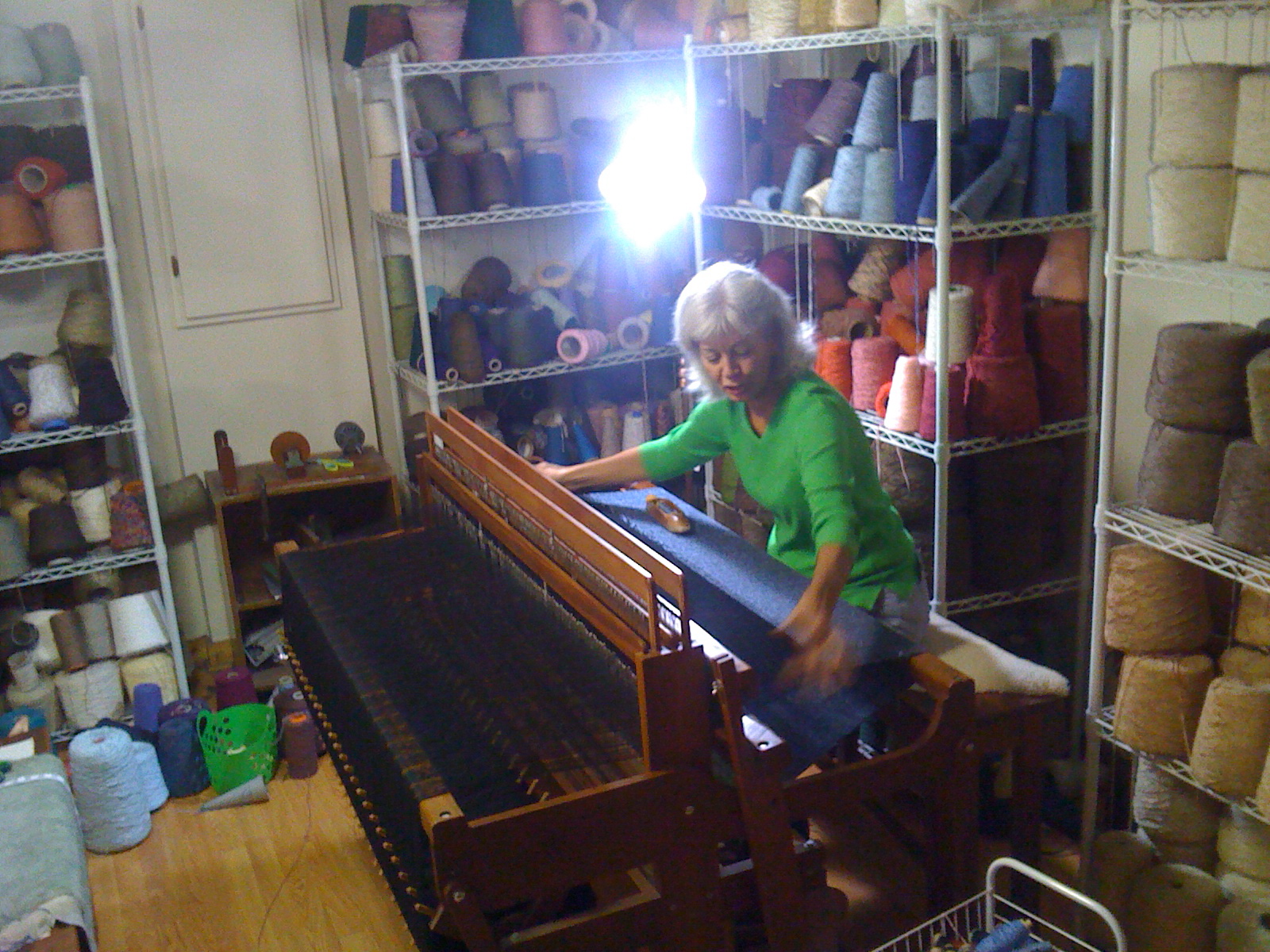
Do you think this weaver is “teleological kind of person?”
Do you have goals? Does your life have purpose? Do you know what you want in this life? If you answered yes to these questions then you are a “teleological kind of person.”
I have often used the subject of purpose in my posts. In April of 2009, I did a specific post about purpose entitled: Do You Know Your Purpose and Worth? It was in that post that I made the following statement: “Until recently I had never thought purposefully about purpose.” You see, I have only recently brought the concept of purpose and its importance in my everyday life to the forefront of my thinking. By recently, I mean these last ten years of my life. I know some of you might think that isn’t what is meant by recent, but for some of us, up there in years, it seems like yesterday. :-)
Let me be clear about what I mean when I write that you may be or are a teleological kind of person. I know that many who hear or read about teleological people assume they are people who prescribe to a certain spiritual or religious belief. I am using teleological as a way of describing the phenomenon of how important it is for us to have goals and purpose in life. For example, think about how having a goal for a good job helps you remain focused toward getting the necessary education to obtain that job. Or, think about how purpose enables you to feel content and fulfilled. These are just a couple of examples where purpose and/or goals can play an important role in our lives.

Goals and purpose are often emphasized in school – why not in life?
When I was teaching, one purpose that I held in the forefront of my mind was to be a good educator and person who constantly thought about how to improve his students’ learning. This helped me to accept the stress, low pay, etc. that came with the profession. My life had purpose and was constantly filled with goals. An example of one of my goals, was to start in the Fall with a Geometry class of non-geometers and end in the Spring with a graduating class of geometers. There were many other goals stemming from my purpose, but hopefully, with this example, you can understand the connection I’m making between goals and purpose.
An interesting point of view, regarding a goal, develops when we achieve it. All of a sudden the goal has been reached and then what? Something we have been working hard to achieve has been accomplished. Now we have nothing to work for. When that happens, many of us tend to “kick back” and do nothing. We feel down and without purpose. Maybe we find ourselves low on energy – lacking the initiative to work as hard as we did before the goal was achieved. How can this be?
Using my previous example of teaching a Geometry class, I would sometimes experience the end of school as both an exciting time and a somewhat depressing time. I would be excited about achieving the goal of bringing my students to the level of passing Geometry, but at the same time, I would be a little depressed because I no longer had that goal to work toward. I no longer had to create solutions to the problem of finding a better way to teach the class. I no longer had to find ways to motivate my class to become the best students they could become. Now, please don’t misunderstand me, I’m only using this partially fictitious example to explain what was “on the edge of my thinking.” Though I had some of these negative thoughts, they were never severe enough to cause me harm. Actually, I think they are normal and as long as they are dealt with correctly, there’s no harm done.

Purpose: “To reach the top” Goal: “Place this block on top”
Well, how should we deal with the let down problem described in the previous paragraph? I think we need to set goals that last through the achieving of a specific one. In other words, we need to have at least one other goal before we achieve the one we are currently working toward. Using my Geometry class example, I needed to set a goal for the Summer after the class before the end of it. And, I usually did. Often times that goal was simply to learn something new that would improve my teaching for the Fall semester.
We need to be sure that goals are continuous and there is always at least one to work toward. There is nothing wrong with taking a break from working toward your goal(s), but you need to be sure it’s your choice and not something you are doing because you have no goals. Make one of your goals to always have a goal! :-)
What is your purpose and what are your goals? If you have purpose and goals, then you’re a teleological kind of person.


 R2 Thoughts for You