 R2 Thoughts for You
How Do You AND Why Should You Make Amends?
Posted on May 17, 2010 2 Comments

Can you make amends by staying here?
Why make amends? If you are sorry and apologize, then why not leave it at that? Should you feel an obligation to make amends?
Before attempting to answer the above questions, let’s establish what is meant by amends. According to Dictionary.com, amends means: “reparation or compensation for a loss, damage, or injury of any kind; recompense.” If you cause a loss, damage, or injury of any kind AND you believe amends are important, then you should recompense.
Do you believe amends are important? Are amends something you value? Ah, so many questions and so few answers! I think, primarily, these are questions you should ask yourself when you have caused a loss, damage, or injury of any kind.

Responsibly Accept-Genuinely Apologize-Reverse Effects
Ok, so if you accept that making amends are important, then what should you do? I think first and foremost, you should responsibly accept that you made the “mistake,” genuinely apologize for it, AND then make the “mistake” right by doing everything you possibly can to reverse effects. To help remember these important parts of making amends, let’s form an acronym from: Responsibly Accept, Genuinely Apologize, and Reverse Effects – RAGARE! Now we have a new word, RAGARE, which gives us direction for how to make amends.

Let’s see if RAGARE will help you make amends!
Let’s see if RAGARE makes sense in a specific example. Suppose you were directly or indirectly responsible for the burglary of someone’s home. Using RA of RAGARE, you would accept full responsibility for your part without blaming anyone else. Using the GA, you apologize in a forthright manner and with explanation, doing all you possibly can to reassure the victim(s) that you won’t do it again. And the RE part directs you toward reversing the effect(s) of the burglary. That might mean you would have to pay for all damages and replace all that was stolen. RAGARE implies that you use empathy, in all of your thinking, toward making amends. In other words, it’s not about your ego, it’s about helping others reverse your negative actions.

How can I Reverse this Effect?
How will you know that you have made amends? After having done the best you can to make amends, considering the process of RAGARE as previously explained, I think it is important to assess whether or not you were successful. How? Use good intellectual standards of fairness, clarity, relevancy, etc. to assess your effort towards making amends. After that, you should work toward re-establishing trust by offering to help anyway you can. Use humility in your approach and use all of your senses to carefully assess her/his reactions. Prove, anyway you can, that you have learned a lesson and then, after you are sure you have made amends to her/his satisfaction, move on.
Finally, let’s be clear – making amends is not the same as confessing, apologizing, blaming others, crying on their shoulders, beating yourself up, etc… – To make amends you must recompense. You must make up or compensate for the lost. Remember, a sincere confession will make you feel better, but to make amends means you must make the damaged party feel compensated for the lost. As you make amends, it’s important that you demonstrate consistently and over an extended period of time, that you are a reliable, kind, trustworthy, responsible and supportive person who has set aside your ego while focusing on recompense.
Why make amends?
<To atone for the damage you are responsible for.
<To set your mind free to move on with respect.
<To free yourself of guilt.
<To get rid of grudges.
<To allow the word “civil” to have meaning in your civilization!
Why should you make amends? Because, it’s the right thing to do!
What do you think?
Can You Think Two Thoughts At The Same Time?
Posted on May 13, 2010 10 Comments

If any thinker can generate two thoughts at one time, this one can!
Can you think two thoughts at the same time? I don’t know about you, but I can’t. I’ll admit that I can cram two different thoughts very close to each other, but I can’t actually hold two thoughts in my mind at the same time. For example, while driving my car I might see a policeman, think about how fast I am going, look at the speedometer and then adjust my speed. In performing this sequence of thoughts, I did cram them together, but at no time was I thinking two of the thoughts at the same time.

Nixon and Presley – Two thinkers, Two thoughts, and at the same time? :-)
Ok, so what’s good and/or bad about this? Why were we designed (for those of you who believe in Intelligent Design) or why have we evolved (for those of you who believe in Evolution) in such a way that we are only capable of thinking one thought at a time? Perhaps, we think in this manner because we would not be able to successfully think any other way. Frankly, I don’t know.
Now, before I continue let me make clear that this idea, of only being able to think one thought at a time, is not necessarily based on any scientific theory or evidence. This is simply what I think and as I’m thinking this, I am only thinking one thought at a time. :-)
From my point of view, being able to only think one thought at a time is helpful for improving the quality of our thinking and life. Consider how much negative thinking is done by us. Consider pessimistic thinking. Consider any thought that is bothersome to you. It may be fear, illness, hate, shyness, danger, rejection, … The list could be almost limitless. How can we get rid of these bothersome and negative thoughts? Well, first and foremost, realize that we can only think one thought at a time!

I’m optimistic that you will stop being pessimistic!
Thinking only one thought at a time gives us the secret to getting rid of negative thoughts. Once a negative thought is identified, you could visualize something that is not negative. For example, suppose you had the negative thought of fear of speaking in front of an audience. Once that negative thought (fear) is identified, visualize something that is neutral or positive and is completely unrelated to the fear.
As an example of thinking a positive thought for the case of, “fear of speaking in front of an audience,” perhaps the visualization of a past birthday party, where you were the center of attention and felt no fear, would help. As you visualize and think this positive thought, you won’t be thinking about the previous thought of fear. The blessing, of being able to only think one thought at a time, enables you to divert your fear to something positive. Now, as you are thinking the positive thought of the birthday party, replace the audience that you were fearful of speaking in front of, with the “audience” at the birthday party. In other words, get rid of, in your mind, the audience you fear. In doing so, you are getting rid of your fear and replacing it with the positive thought of enjoyment and friendliness.
Of course, this technique has to be practiced and success won’t happen instantly. But, knowing that you can’t think two different thoughts at the same time does give us a tool for improving our thinking and possibly, our quality of life. In one sense, I guess multi-tasking, from your “brain’s point of view” is not possible. :-)

Are WE thinking the same thought?
How about picking out one of your thoughts and sharing it in a comment?
How Is The Human Brain Like A Pencil?
Posted on May 10, 2010 2 Comments

What a “sharp” idea!
How is the human brain like a pencil? You probably have already guessed at least one possible answer.
Here are some of my answers:
>They both need to be sharpened for the best performance.
>It’s what they have inside that’s important.
>They are only useful when used.
>It’s possible to erase what they produce, yet often times, a little “residue” remains.
Now, of course, I am using the pencil as a metaphor. The two (pencil & brain) are quite different. On the other hand, the first comparison of the two, where I state that they both have the need for sharpening in order to have the best performance, is powerful. An unsharpened pencil and brain both work, but not as well as sharpened ones. Let’s explore, a little deeper, this need for sharpening the brain.
It is very easy to get stuck in a routine of doing the same things, going to the same places, socializing with the same people, eating the same foods, drinking the same drinks, waking up and going to sleep at the same time, etc. Many people are literally stuck in a rut.
Being stuck in a rut is an example of a brain that isn’t being sharpened. In order to sharpen your brain, you need to do something you do not know how to do. You must learn new things in order to sharpen your brain. If you don’t know how to garden, then learn how. If you don’t know how to do crosswords puzzles, then learn how. If you don’t know how to use a particular piece of software for your computer, then learn how. The key is to force your brain to learn something that is new and non-simple.

Maybe this will also sharpen my brain! :-)
Learning new things can help keep you and your brain fit. Often the new thing you learn can help with both, mental and physical fitness. Therefore, you could use the act of sharpening your brain as a way to temporarily achieve total fitness. I used the word “temporarily” in the previous sentence because I don’t think it is wise to repeatedly use the same mental act. Anything we always mentally do can eventually end up not giving us any meaningful results. A simple example of this is driving a car. When I first learned to drive – at age 14 – I found it to be mentally challenging. After awhile, driving became such a simple routine that it was no longer challenging. It’s important to “mix-up” our mental challenges in order to sharpened the brain. Similar to doing the exact same physical workout everyday, doing the same mental workout will eventually result in little or no appreciable results.

Is a mechanical brain like this “pencil?” Never needs to be sharpened.
Finally, as some of you may have read in earlier posts, one of the reasons for my blog is, “writing for learning.“ In an earlier post entitled, “My Writing, Dementia and Mother,” I explained that this mental exercise of writing my blog for learning, hopefully, would also”ward-off” dementia. Of course, I have no evidence that it will, but I don’t see how it can hurt.
So, how is the human brain like a pencil? As mentioned in the first paragraph, they both need to be sharpened for the best performance. Oh, I almost forgot, they also have to be used in order to be useful! :-)
How about a sharpened comment?
What Makes A Person Wealthy?
Posted on May 6, 2010 Leave a Comment

A “wealthy man” leisurely walking in the woods.
Do you know anyone who is wealthy? I do. Do you know anyone who is really rich? If “really rich” means the person is a multimillionare, then I don’t personally know anyone. Of course, I know names of very rich people, like Bill Gates, Warren Buffett, etc., but I don’t know them. I just know of them.

Are “leisurely birds” wealthy?
Probably, by what I stated in the first paragraph, you can see that I am not using the word wealth in the sense that Adam Smith did in his book, The Wealth Of Nations. I agree that many, if not most people, consider wealth to be directly related to a condition that is reached through money. A person might work real hard and through her/his efforts attain a lot of money and therefore, be considered wealthy. Or, the money might be acquired through cheating, lies or even betrayal and still, the person could be wealthy.
Looking at wealth from only a monetary point of view, leaves most of us with a future of never being wealthy. But, if we look carefully at all of the variations of the definition of wealth, we can find hope that allows all of us to be wealthy. Consider the following secondary definition of wealth: “an abundance or profusion of anything; plentiful amount.” Now, let’s use that definition and consider non-monetary important aspects of life, like: leisure, good health, peace of mind, happiness, good relationships, purpose, loving what you do … Immediately, I get a different view of wealth. Suppose I have an abundance of good health, peace of mind and good relationships? By definition, I am wealthy and frankly, I think that is an excellent way for all of us to attain wealth.
Suppose you reduce all of your “needs” until you have only the minimum required for a healthy life. Perhaps you give up a full-time job and after reducing your “needs” you are able to get by on part-time work. Now, you have more leisure time. Instead of being in the rich class and/or working class you now are in the leisure class. You have an abundance of leisure or a plentiful amount of free-time. You are wealthy!

Yea! I’m poor, but I’m wealthy!
The point is that there is more than one way to become wealthy. You can become wealthy through money by working, inheriting, scheming, stealing, betraying, playing, cheating and lying. Of course, this list is not complete and the chances that you actually attain the status of being wealthy are low. Most people on earth will never be wealthy due to the amount of money they have. On the other hand, most people could be wealthy, if instead of money, they based their wealth on health, peace of mind, leisure, good relationships, and/or …
Do I know anyone who is wealthy due to the amount of money s/he has? No! Do I know anyone who is wealthy through good relationships, peace of mind, leisure, health, …? Absolutely!
Are you wealthy?
Why Two Ears, Eyes, and Nostrils, But Only One Mouth?
Posted on May 3, 2010 Leave a Comment

Two Ears, Eyes, and Nostrils, But Only One Mouth!
Two ears AND only one mouth? Why not a mouth for each ear? Why does your broadcaster (mouth) consist of one and your receivers (ears, nostrils, and eyes) consist of two. Of course, your sense of touch has “multi-receivers” from almost every part of your body. But, again, we each have only one major broadcaster – a mouth. Wow!
So, why did you evolve or were created this way – two ears, two nostrils, and two eyes, but with only one mouth? I realize that there may be a “good” scientific and/or religious reason, but for this post I am going to keep my reason(s) more philosophical.
“We have two ears, so we will listen twice as much as we speak?“ That quote is from the Greek Philosopher, Epictetus who lived around 100 AD. What about the other senses, such as, two nostrils – to smell twice as much as you speak? Two eyes – to see twice as much as you speak? And, multi-ways to touch – to feel many times more than you speak?

I’m listening twice as much, but not with those “things” on top of my head! :-)
I think to be able to speak with ONE and to receive (listen, smell, see, touch) with TWO or MORE is an interesting relationship. We have other systems in our lives that reflect this same concept of receiving more than giving. Consider the act of learning. Many times we have to receive much more than we are able to give. I know, personally, that when I had to write a research paper, I would receive (and process) much more than I would actually give – demonstrated by my end-product, the research paper. How about the amount of “news” all of us receive from the news media and the amount of news we actually give the news media? From my point of view, the imbalance is greatly skewed toward receiving much more than what is given. Compare how many times you are involved with something that is newsworthy and the number of times you receive something that the news media deems newsworthy. I think you will find it to be heavily weighted toward receiving what they give, instead of the media receiving what you give. Come on, you know it’s that way! :-)

I shouldn’t talk twice as much as I listen?
Let’s go back to the Epictetus quote and focus on the language arts’ use of our ears and mouth – listening and speaking. Should we listen more than we speak? I don’t think there should be a hard and fast rule stating that, BUT we should consider that as a long-term goal. In other words, we should always be willing to set aside our egos and just listen. When someone is talking to you, it is respectful and proper to listen. Actually, the act of listening allows you to outwardly give the gift of your presence. It’s a way to demonstrate that you are “present in the present!”
So, let’s take a cue from the fact that we have two ears and one mouth – let’s listen twice a much as we speak!
Why do we have two ears, eyes, and nostrils, but only one mouth? To listen, look, and smell twice as much as we speak! :-)
I would love to see a comment!
Is Your Brain Responsible For Your Thinking?
Posted on April 29, 2010 Leave a Comment

Is the brain or mind responsible for this perception?
Is there a difference between your physical brain and your thinking? Does your mind do your thinking? Does your brain do your thinking? Does your brain contain your mind? Is your brain contained “within” your mind?
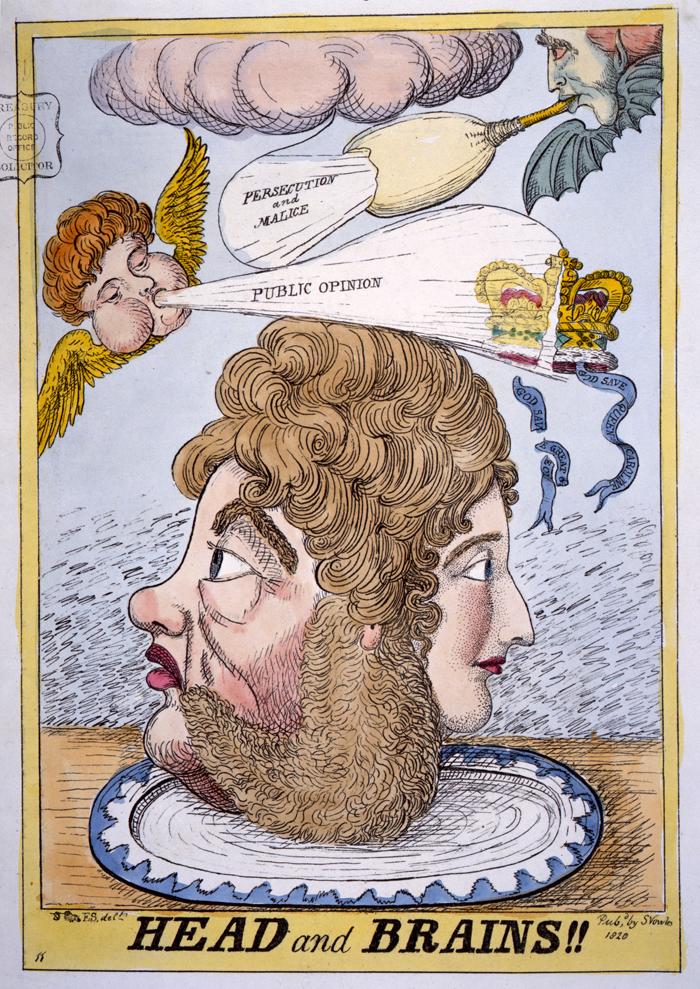
Satire on George IV in support of Queen Caroline, his estranged wife. The new king spent much of the lead up to his coronation trying to get rid of her. Date: 1820
Honestly, I don’t know the correct answer to any of the above questions and I don’t think that the important part of understanding your thinking depends upon it. You see, from my point of view, “the brain” is like the dynamic world we live in.
Your world changes and your brain changes. How does your world change? How does your brain change? The answer to both is, “Your world/brain changes when (the) part(s) of it change.” What are the parts of your world? Everything that affects you. What are the parts of your brain. Everything that affects it. Maybe I should replace “it” with “you” in the previous sentence. If I did, then your world contains your brain AND your brain contains your world. Now that I think about it, that’s true. How could my world not contain my brain? How could my brain (from a thinking perspective) not contain my world. All of this is, from my point of view, an example of combining: Buddha’s We are what we think , Shakespeare’s Thinking makes it so , & DesCartes’ I think, therefore I am!
Ok, so what about the question posed in the title: “Is your brain responsible for your thinking?” Well, I do believe that your brain is the receiver of the mind. In other words, the mind, whatever and wherever it is, has a “thing” that receives information, memory recall, reasoning, etc. and that thing is the brain. This is only my paradigm for helping me make sense of the relationship between the brain, mind and thinking. Of course, you might have a “paradigm shift,” therefore causing your way of thinking about the relationship to be completely different. Paradigm or a paradigm shift, it doesn’t matter as long as you “mind your thinking.” :-)

My mind says I’m holding my brain!
So, is your brain responsible for your thinking? Well, suppose you die. When you’re dead, your brain will soon not exist. What about your thinking? For the sake of discussion, let’s say that our thinking is in our mind. When we die, so does our brain. If our brain is the thing that “receives” our thinking/mind, then it seems reasonable that something else could take its place.
Using a metaphor, we could think of the brain as a radio and thinking as a radio signal. When the radio is gone, the radio signal isn’t. Another radio (brain) can receive the signal (thinking). This metaphor also helps explain how some thinking is better than others. Different brains (radios) perform differently. Some (radios/brains) can receive weaker signals and clarify them better than others. Some have more power or stronger batteries than others. In other words, if our brain (radio) is of high quality, then it will be able to receive more and better signals (thinking/mind) than one of less quality. Perhaps, this is how the thinking animal (human) has made so much progress over time.

Is it my brain or my mind that hurts so badly?
Is your brain responsible for your thinking? Yes, like a radio is responsible for receiving radio signals. The brain is “responsible” for receiving!
My brain and/or mind looks forward to receiving your comment. :-)
Zen And The Building Of A Rabbit Trap???
Posted on April 26, 2010 1 Comment

The (box) Rabbit Trap!
What zen is there to building a rabbit trap? Good question, but before I attempt to answer it, I think I should explain what the word zen means to me.

I’m meditating on how to catch a rabbit!
Whenever I hear or see the word zen, the first thing that comes to my mind is meditation. I know that formally, zen refers to the School of Mahayana Buddhism, which asserts that enlightenment can come through meditation and intuition rather than faith. Therefore, zen does seem to imply meditation. For purposes of clarity in this post, let’s agree that zen means a meditative experience that helps with enlightenment.
So, the zen that I experienced from building a rabbit trap might/should have lead to some form of enlightenment. And, that begs the question, “What is enlightenment?” Enlightenment refers to a unique experience which wholly transforms an individual from some previous state. I realize that my way of viewing zen, meditation and enlightenment aren’t necessarily in agreement with the Buddha, but for the purpose of explaining my experience of building the rabbit trap, it should suffice. Perhaps the best way to think of the zen of building a rabbit trap is to compare it to some of the writings of Robert Pirsig in his book, “Zen and the Art of Motorcycle Maintenance: An Inquiry into Values” Instead of sharing “zen thoughts” while traveling on a motorcycle trip, as Mr. Pirsig did, I shall share some thoughts I had while building a rabbit trap.

There’s bad karma associated with this trap!
So, why did I want to build the rabbit trap? Well, last Summer I was talking with my neighbor, over the fence, and she said she would like to get rid of the rabbits that were eating freely from her garden. She didn’t want to shoot them (illegal to do so in our city) and she was unsuccessful when trying to trap them with a Haverheart trap. I responded with, “Why don’t I build you a rabbit trap like the ones I made (box traps) when I was younger and lived on a farm?” Guess what? Last week, she reminded me of that conversation and said she would like for me to build her a trap. And, that I did! Why? Because I was trapped! :-)
As I was building the trap, I had to think about the design of each part. You see, I did not have a set of instructions to follow, but instead, I was drawing from my memory, as a teenager, when I built them while my family and I were living on a farm. I hadn’t built a trap in over fifty years. Isn’t this a reflection of life in general?
Don’t we or at least, shouldn’t we, think about the design of each part of our life. When we plan for a part of our life, aren’t we working on our life’s design? When we are visualizing what we want for our future, aren’t we again working on our life’s design? I think planning and visualization are two important skills we need to use with regularity and they both should be used while thinking about the design for the many parts of our lives.

Rabbits don’t like to go into this Havahart trap!
Another important part of building the trap forced me to focus on the rabbit it was designed to catch. My neighbor did not, nor does not, want to harm any rabbits. She simply wanted to remove any rabbit that might eat her flowers or vegetables. She had a Havahart trap (a trap designed to not harm the animal it catches), but it is visually open on all sides and rabbits generally don’t like going into such an apparatus. The “box trap” that I used on the farm is only visually-open on the ends. This enables the rabbit to have a feeling of being protected from predators above and on each side. In other words, from a rabbit’s point of view, when going into a box trap, it is entering a burrow or brush-pile. Therefore, I was having to use empathy (looking at life from a rabbit’s point of view) to build the trap.
Relating the “looking at it from the rabbit’s point of view” to our lives, isn’t it important to use empathy in our thinking? Mentally, putting ourselves in the shoes of others, enables us to better understand our own life. As I was building the trap, I had to imagine that I was a rabbit. By doing so, I was forced to consider how the rabbit would “think” about this trap that I was building to catch it. I was literally forced to think empathically. I think the fostering of intellectual empathy is important for all thinking humans. And, here I was fostering intellectual empathy by thinking from the point of view of “Bugs Bunny!” :-)

Entering the box rabbit trap from the rabbit’s point of view!
The final aspect of building my box rabbit trap was testing to see if it worked. In other words, I had to assess the results of my design/thinking. Did the “trigger” work? Was is big enough? Perhaps, it is too small. Maybe the door wouldn’t close as designed.
When I tested the trap, the first thing I noticed was that the “trigger” was too sensitive and the door was too wide. Of course, I had to correct both of those imperfections. Isn’t there a life lesson here when we think about solving problems in life? When solving life problems, we should plan or visualize a solution, empathically think from different points of view and then assess our thinking using reasonable intellectual standards. This is what I did while building the trap; this is what I should do while solving life-problems. A lesson or way of life? Either one – your choice!
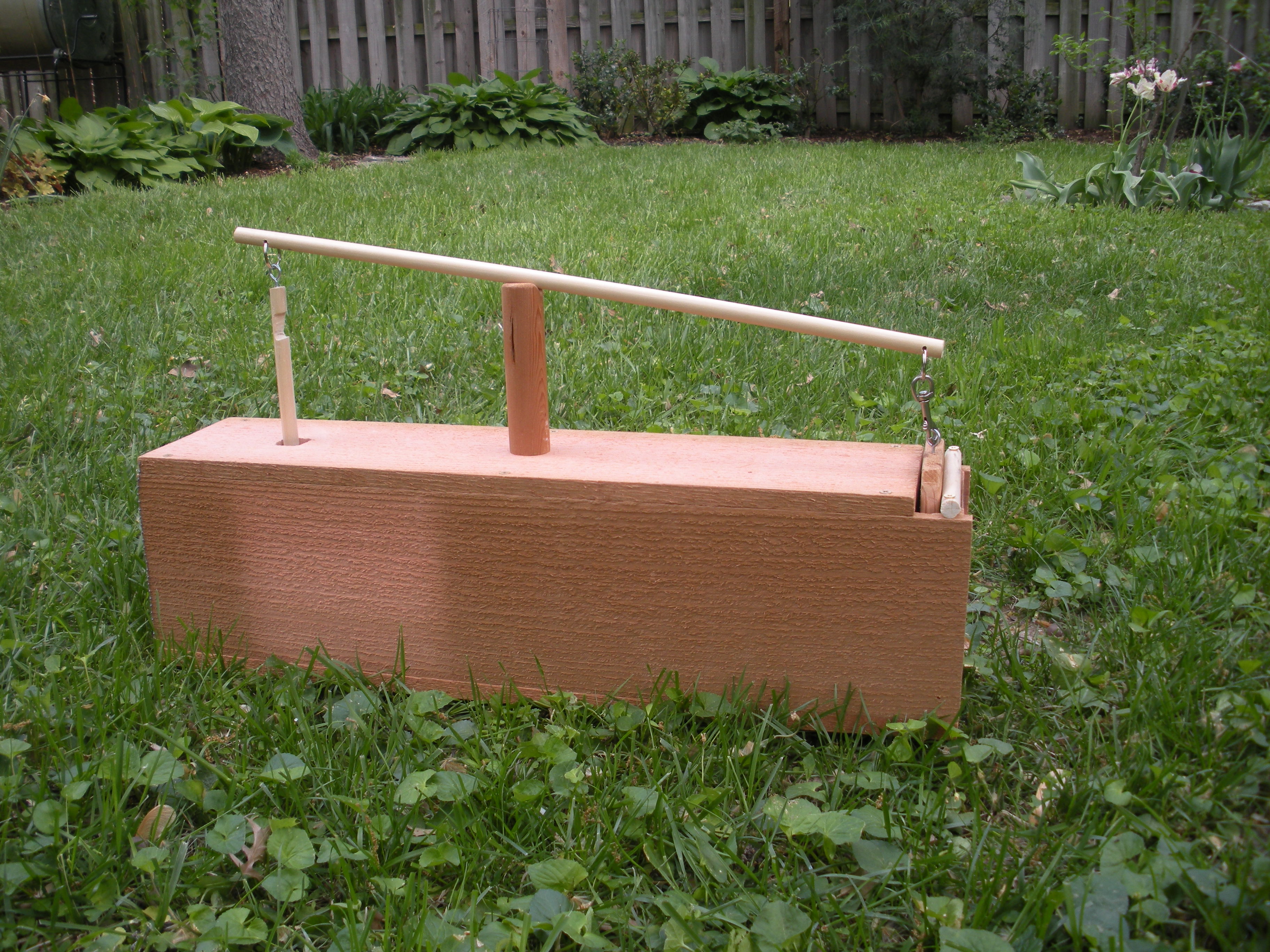
What a trip! It’s a “tripped” trap! :-)
So, what was the zen, for me, while building my rabbit trap? As I built it, I was meditating on three important aspects of life (design, empathy & assessment) and had an unique experience of being transformed from the state of observing nature to the state of being part of nature. Bugs Bunny might say to my previous statement, “Weally?” And, I would say, “Really!” :-)
I end with a few more wise words related to catching rabbits from Bugs Bunny: “You know, some day these scientists will invent something that will out-smart a rabbit.” AND “That’ww hold him awight. Hee-ee-ee-ee! Phooey!”

Ehhhh, That’s all folks!
Are You Producing More AND Are Less Productive?
Posted on April 22, 2010 Leave a Comment

They are producing, but are they productive?
How can you produce more and be less productive? Have you ever been real busy, but know that you haven’t been very productive? Well, I’ve had that happen to me many times. Sometimes, at the end of the day, I am completely worn-out from having been busy all day, yet I haven’t really produced what I wanted. Even as a retired person, I have felt this way. Why and how does this happen?

Producing strokes for a productive kayak experience!
I think the above questions are important ones to consider when trying to quantify a person’s performance. Too often, one’s performance it assessed based on how busy instead of how productive a person is. There are many times when producing (being busy) does not make us more productive.
For some examples of producing more and being less productive, let’s first consider the assessment of a teacher. Many educators are given a good assessment simply based on the number of college credit hours s/he has successfully attained instead of how well the teacher teaches. Producing more college credit hours does not necessarily make the educator more productive as a teacher. In a similar way, a student is often rewarded a grade based on how many assignments are turned-in instead of what the s/he has learned. Another example is rewarding a person a large payment based on producing a large number of clients, instead of producing clients that actually help the company’s profit. The point is, even though you produce a lot, you may not be a productive person. It all depends upon what you are producing and how that enables you to be productive.
How many days have you spent being constantly busy and when the day is over, you’re disappointed with what you have accomplished? How can this be good for you? Generally, when you are constantly busy and accomplishing little, you will push yourself even harder the next time to get more done. Isn’t this stressful? Of course it is!

Busy on the “hamster-wheel of life!”
I don’t think we should push ourselves harder when what we did before was not getting us the production for the effort produced. You see, when this is happening, our plan, goal, purpose and/or priority is out sync. We need to develop a clear purpose, set a few short-term and long-term goals and stop running like we are on a hamster-wheel.
If you are doing more and accomplishing less, then maybe it’s time to slow down, reassess and approach what you’re doing in a different manner. Again, develop a clear purpose, set a few short-term and long-term goals and know that you are moving in the right direction toward being more productive.
It is important that we have a clear purpose with reasonable goals. We don’t want to be swimming toward an island and realize that what we thought was an island is a mirage, or the island is many miles further than we can swim. Ouch!
So, let’s all focus on being productive and not on producing!
How about a “productive” comment to show what you are mentally producing? :-)
If Questions Drive Thinking, Then Where Are You Driving?
Posted on April 18, 2010 Leave a Comment

Question is driving Thinking! :-)
I have often used the saying, “Questions drive thinking and answers end thinking!” I believe the statement, as long as it’s not used as an absolute.
As a general rule, we should always question. I don’t mean we should always ask questions verbally, but our minds should be questioning minds. We should have the attitude that when one question is answered, then we form two more. This enables us to have an inquisitive mind that is forever growing with the number of questions growing in a mitosis manner.

“I question your driving and NOT that questions drive thinking!” :-)
Now, asking just “any question” is not what I am talking about. It’s important that your questions are focused on solutions and not problems. For example, you might ask someone, “What do you really want?” instead of, “What is wrong?” Consider asking, “How would you like to change things?” instead of asking, “How did things change?” The point is that you should usually ask questions that will help find a solution instead of focusing on the problem. I included usually in the preceding sentence because questions asked for the purpose of clarification are an essential use of questioning and often, are not directly seeking solutions. So, do ask questions for clarification, but once you are clear about the problem, then direct your questions toward the solution instead of the problem. Perhaps the best overall approach is to first ask questions for the clarification of the problem, and then ask questions for the purpose of finding the problem’s solution.

Who drives the blimp?
It’s difficult to always be optimistic, but in every situation there is an outcome that is desirable. What I mean is that focusing on the situation and how it’s so bad, will only help us have one outcome – a bad one! Of course, we should try to make our thinking fit reality, but that doesn’t mean we should allow our present day reality to be our future. For example, if we are faced with the reality of a broken down and worn-out car, we shouldn’t focus on the old car and accept it as the only car possible for us. Instead, we should accept the reality of the condition of the car and either fix it or get another one. Though this might not be the best example, it is one that I have had to deal with recently. Focusing on the dark and dismal aspect of a situation usually only leads to a dark, dismal and undesirable outcome.
So, when we are allowing questions to drive our thinking, we are in the “driver’s seat” for doing good thinking. But, only if we are a good driver! In order to be a good driver for our thinking, we need to ask questions that help solve problems instead of creating them. We need to focus on solutions and not problems. Consider focusing on questions that ask what and how and not why, who and when. Don’t ask “Why Ron broke the television?” Instead, ask “What is Ron doing to fix the broken television?” or “How is Ron going to fix the television?”
If questions drive thinking, then where are you driving? I hope you are a good driver and driving toward solutions instead of problems.
Any questions? :-)
Do You Have The Right To Have Rights?
Posted on April 15, 2010 Leave a Comment

This building is in St. Augustine, Florida, the oldest city in the United States. From 1605 to 1765, under Spanish rule, there stood on this site a guard house and water tower. Later under British rule, it became a market and place of public auction and ever since, called the Slave Market. What justified RIGHT allowed people to use this site for a slave market?
What rights do you have? No, I’m not referring to your constitutional rights or your family rights. I’m not even referring to your copyright (if you have one:-)! The rights that I’m referring to are similar to those that were mentioned in the Declaration of Independence in 1776. In the Declaration of Independence, our founding fathers declared that we have the right to life, liberty, and the pursuit of happiness. Do we?
Where do these rights come from? If I declare that I have the right to death, do I? Suppose I declare that I have the right to be healthy. Who or what gave me that right? Or, do I have that right? Oh, so many questions and so few answers!

Do I have the right to kill this insect?
Last August I wrote a post entitled, “Is Obama’s Basic Affordable Health Care For Everyone A Right Of Citizenship?“. Please click on the title to direct your browser to it. In that post, I argued that if basic affordable health care is not a right of citizenship in America, then it should be. If I’m correct, then where does that right come from? Is it a basic human right? Would we have to pass a law to make it a legal right? Should we amend the constitution to make it a constitutional right? If a religion organization declared it a right, then would it be a religious right (not THE religious right:-)? Could it possibly be a “moral” right? Really, where do rights come from? Is there really any such thing as a “God-given” right? Again, so many questions and so few answers!
So, do we have the right to have rights? Do we have rights simply because we are human beings? I think the answer to this last question is, yes!
Like the rights in the Declaration of Independence, we have “given” ourselves many rights. Here are many examples:
We have the right to not be perfect.
We have the right to feel good about ourselves.
We have the right to make choices.
We have the right to live.
We have the right to breathe.
We have the right to choose how we will use our time on earth.
We have the right to express ourselves.
We have the right to question.
We have the right to seek help.
We have a right to privacy.
We have a right to defend our rights.
We have a right to our beliefs.
I’m sure there are many more rights we could declare that we have, but perhaps my question in the title of this post still remains unanswered: “Do you have the right to have rights?”

Read me your rights!
How can I justify that you have the right to have rights? I think it’s really difficult to justify because it is multi-dimensional. For example, you might have a right legally, but not morally. The right to abortion might be such a right for you. Another example is the constitutional right of bearing arms. Even though it’s a constitutional right, there are many places in America where it’s illegal to carry a gun. For example, when I was teaching, it was illegal for me to bring a gun into school. Many rights are relative, meaning rights depend upon a what, when, where, and/or how the rights are used.
Do you have a right to have rights. Yes, and that may be the only right that you “absolutely“ have. All other rights are relative and depend on what, when, where, and/or how they are justified. Oh, so many questions and so few answers! :-)
You have a right to give a comment. Please exercise that right. :-)


 R2 Thoughts for You