 R2 Thoughts for You
Are Truth and Lies Like Yin and Yang?
Posted on August 8, 2009 Leave a Comment
 Recently, my granddaughter suggested a topic for a posting on my blog. She made a comment on a recent posting asking me to write this post. She even suggested that I use a “yin and yang” format. I couldn’t agree with her more, though I must admit that I was not able to adhere to a strict “yin and yang” format. In fact, I had a discussion with her about the duality of “truth and lies.” We discussed whether the opposite of truth is a lie and vice-versa. Much of our discussion involved whether telling the truth is always the best policy. For example, if someone asks you whether or not you like her recent hair style and you don’t, should you be truthful?
OK, so what are my thoughts regarding truth and lies? Well, first of all, a well-known statement comes to mind: “the truth hurts.” I have heard that many times and agree that the truth often does hurt. Of course, the truth will hurt when the truth is not what you want to hear and your self-esteem depends on it. Often times we want to hear the opposite of truth in order to enhance our self-esteem. But really, isn’t self-worth more important than self-esteem? Why maintain self-esteem and lower self-worth?
I think we sometimes know the truth when we ask a question, but the truth is not what we really want to hear. Why? Because it will hurt our feelings. What we really are hoping for is that someone will tell us what we want to hear and not necessarily what is the truth. In this case, lying to protect the person’s feelings seems like an easier way to keep whatever relationship we had before the lie. Actually, I think lying to protect someone else’s feelings can be very damaging in the long run. When we know the truth and we tell a lie, we have to then know both, the truth and the lie. This leads to confusion and dishonesty in the relationship. I think humans are “programmed” to seek the truth. Lies go against human nature.
Let’s focus on truth and lies in relationships, and not in, for example, law, sports, government, politics, contracts, business, retail, etc. Lying to someone, no matter what the relationship is, can be devastating and may undermine the integrity of the relationship for a very long time. Think about it, how do you feel about someone lying to you? Do you really want those around you to keep truths from you that they think aren’t what you want to hear? Or, would you rather hear the truth, no matter what?
Consider the yin and yang of it. What do I mean? Well, in our minds, when we consider telling the truth, we must weigh it against the apparent hurt that the truth will cause. In other words, we need to seek balance. For every truth, there is a lie that could be told. But, how do we know how much the truth will help or hurt as compared to a lie? We don’t! But, if we lie, we must know that what we did is not “real.” We are attempting to “live a lie.” We are trying to make reality fit our thinking instead of making our thinking fit reality. Eventually, we will have to face reality (since the only place we can live is in reality) and “own up” to our lie. This happens constantly in life. For non-relationship examples, consider such issues as global warming, war, Enron fraud, Bernie Madolff, etc. All of these have lies at the center of the problem. I’m not proposing they are lies, but just that they became a problem because of lies.
How do you like the truth? Up front with no regard for your feelings? Or, do you like it tactfully, with affection and softness, such as “Please remember, we said we’d be up front and truthful with each other, so here it is…” or “I don’t know everything, but here is what I think about…..”
 I think that the truth doesn’t have to hurt. It’s not the truth that many people don’t want to hear, but the spirit in which the truth is given. What really hurts is feeling we have to cover up our true thoughts and emotions. If we want our relationships to get bigger and stronger, then honesty and truth must be our ultimate goal.
Of course, we will not always be truthful. That is human nature, which is in all of us. Since we are human, we are not perfect. Having stated that, it’s important that we set aside out ideas that deception of those close to us is something we should do for anyone’s good. Hiding the truth leads to living a life of lies. None of us need that. What really hurts us are lies. The truth does the opposite, it heals. The truth sets us free! Set yourself free in life and never have to worry about what is right or wrong. Be an imperfect person who strives to be a truthful person. That’s making your thinking fit reality!

Papou Thanks Katie!
Tackling Tonguing Tough Tongue Twisters!
Posted on August 6, 2009 Leave a Comment

Tongue “stucker” or twister?
Today, let’s have some fun with tongue twisters. Besides fun, we can also help ourselves become better at pronunciation. Fun pronouncing to improve pronunciation. Wow!
First, here are a few short ones to warm us up.
Red lorry, yellow lorry
Unique New York
Greek grapes
The epitome of femininity
Which wristwatches are Swiss wristwatches?
Supposedly, the toughest little tongue twister in the english language is:
“the sixth sick sheik’s sixth sheep’s sick.”
What do you think?
Some well known tongue twisters are “short poems.”
A skunk sat on a stump and thunk the stump stunk, but the stump thunk the skunk stunk.
Imagine an imaginary menagerie manager imagining managing an imaginary menagerie.
She stood on the balcony, inexplicably mimicking him hiccoughing, and amicably welcoming him home.
Some can be a little “dirty.”
I slit the sheet, the sheet I slit; and on the slitted sheet I sit.
One smart fellow; he felt smart. Two smart fellows; they felt smart. Three smart fellows; they all felt smart.
Is there any value to tongue twisters? In other words, other than fun, do tongue twisters help us in any way? Yes!
Teaching poetry to children is one value of tongue twisters. They serve as attention grabbers and help children to keep their focus on the lesson.
When learning another language, tongue twisters may help. They force the mind to concentrate on pronunciation.
Perhaps, the greatest value is “having fun with language.” Learning is a joyous and fulfilling experience. Tongue twisters can make it “funner.” (more fun:-)
How about a tongue twisting comment from you?
Quotes, Questions and Answers!
Posted on August 2, 2009 2 Comments
Note: This post contains quotes that I have been using for awhile. I am unsure if any of them are verbatim from some single source. If you know a direct source of any of them, I would appreciate a comment.
◊ Responding to “questionable” quotes. :-)
“There is a mysterious connection between language and thinking.”
How can we access our thinking?
Since it is difficult to think without using (one’s own) language, the natural way to access thinking is through language. The tool to use is the language arts. To access and improve our mathematical thinking we must READ THE MATH, WRITE THE MATH, HEAR THE MATH, SPEAK THE MATH, therefore THINK THE MATH. This is true for all academic learning.
“Choose freely, live creatively, and think critically.”
What does this mean?
Choosing freely means you are choosing and accepting the responsibility of your choice. Living creatively means you are living in a way in which you are creating the meaning of life in your mind. Thinking critically means you are thinking about your thinking and assessing your thinking with good intellectual standards–clarity, relevancy, appropriateness, logicalness, etc. As a problem-solver, citizen, parent, student, teacher, legislator, professional, or any other label one might have, the focus statement of “choose freely, live creatively, and think critically” can keep us directed toward rationality. By rationality I mean, conforming to principles of good reasoning, showing good judgment, being sensible, logical, and relevant.
“What you are becoming is often more important than what you are accomplishing.”
What are you becoming?
A life-long learner? Yes, but what are you learning? It is important to “become” the learner that has good intellectual traits, such as intellectual empathy, intellectual courage, intellectual humility, intellectual perseverance, and fair-mindedness. With good intellectual traits the thinker can be a life-long learner who is productive in a positive manner in a democratic society. The “becoming” is acquiring good intellectual traits and the “accomplishing” is life-long learning.
“Questions drive thinking.”
Why focus on questions instead of answers?
Asking questions is a sign of thinking. Questioning is necessary in order to keep your thinking active. Questions do not need to be asked to anyone but yourself. In fact, the goal, though not attainable in most situations, would be to answer all of your own questions. For every question you ask, ideally your mind will generate two more. Therefore, if you start with one question and pursue your line of thinking, you end with many questions. Questions are a sign of an active mind and not a sign of ignorance. Use questions to drive thinking.
“Know yourself.” “Be true to yourself.”
Who should assess our thinking?
Ultimately, each person must assess him/herself. As you know, you don’t always have another person to assess your thinking. We must constantly work toward the time in which we will assess our own thinking and decide for ourselves its clarity, accuracy, relevancy, appropriateness, etc. Self-assessment should be done on everything that represents one’s own thinking.
“Metaphorically speaking in education, the journey is more important than the destination.”
When are we learning?
We are always learning. The question is, what are we learning? We must view our journey of life as the important time for learning and not just the end of our formal schooling as the time we are learned. Education is never ending. It is like life, in the sense that as long as you are alive, you are also learning. The only destination is to be a life-long learner. When are you learning mathematics, language arts, science, history, etc. ? ALWAYS!
What Is Your Response To “Obama’s Socialism?”
Posted on July 30, 2009 Leave a Comment
Recently, I received the following “forwarded e-mail.” It is, in my opinion, an attack ad on our current administration. After the quoted e-mail, I give my response. I realize the e-mail is a metaphor explanation and mine is specific to health care. I hope this stimulates good thought.
—————————————————————–

A professor explaining President Obama’s Socialism??
“An economics professor at a local college made a statement that he had never failed a single student before, but had once failed an entire class. That class had insisted that Obama’s socialism worked and that no one would be poor and no one would be rich, a great equalizer. The professor then said, “OK, we will have an experiment in this class on Obama’s plan”. All grades would be averaged and everyone would receive the same grade so no one would fail and no one would receive an A.
After the first test, the grades were averaged and everyone got a B. The students who studied hard were upset and the students who studied little were happy. As the second test rolled around, the students who studied little had studied even less and the ones who studied hard decided they wanted a free ride too so they studied little. The second test average was a D! No one was happy. When the 3rd test rolled around, the average was an F. The scores never increased as bickering, blame and name-calling all resulted in hard feelings and no one would study for the benefit of anyone else.
All failed, to their great surprise, and the professor told them that socialism would also ultimately fail because when the reward is great, the effort to succeed is great but when government takes all the reward away, no one will try or want to succeed. Could not be any simpler than that.”
—-R2’s Response—-
Dear Dan,
Regarding the e-mail on socialism, much has been said about how Obama’s approach to health care is socialism. Since I don’t know exactly what the professor is referring to, I have chosen health care as a topic to consider. First, let me state that I personally believe that good reasonable health care for every American citizen is not a reward or a grade for what the citizen knows or can do, but instead, is a right of citizenship.
I think it is a right and should not be based on decisions made for increasing the profit of shareholders. I know many are saying that somehow this amounts to socialism. I disagree and frankly, think many who say it is socialism, don’t know what socialism is. Here is a place to start when considering socialism. The next step (using the metaphor in the e-mail) for anyone wanting to learn more about socialism, is to study, take tests and know, up front, that all grades will be averaged. Etc., etc. But, who decides what socialism is? By the way, “what is a reasonable and clear definition of Obama’s Socialism?”
Of course, we already have “socialized” healthcare for one segment of our society; it’s called Medicare. I know many people who want and get more than the coverage that Medicare offers. Some of these financially fortunate people are able to buy the services of a boutique/designer doctor. Some, because they were gainfully employed and earned enough money, are now able to have both, Medicare coverage and the services of a boutique doctor. The result is they have “better” health care than those who are only on Medicare. If this is an example of “socialized” medicine, I fail to see how socialism is such a bad concept.
I want something similar to Medicare for friends and relatives of mine who are not old enough to qualify for Medicare and do not have health care. They do not have jobs that provide reasonable health care and do not make enough money to afford to buy it on their own, therefore they do not have health care. When they get sick they go directly to the emergency room or sit at home and hope they get better. Is this an example of a good health care system for the “greatest nation on earth?”
My wife and I are both retired and not old enough to be on Medicare and we had to pay 15% of our entire (gross) income on insurance premiums last year. And of course, we have co-pays for everything. The bottom line is that last year we paid over 22% of our (gross) income for health care AND we weren’t really sick!
ick!
Socialism is not a good or bad word, anymore than democracy or capitalism are good or bad words. There has been many bad “so called” capitalistic systems. Perhaps the past American slave trade is one bad “so called” capitalistic system. There has been many good “so called” socialistic systems. Perhaps, Medicare is one of the good “so called” socialistic systems. ????
Smile, if you have reasonable health care. :-) Frown, for those who don’t. :-(
Best Regards,
Ron
—Any comment(s)?—
Is It Good, Even If It Isn’t Accurate?
Posted on July 27, 2009 1 Comment

Is it true?
Recently, I received an e-mail from my sister in which she was forwarding something that was, supposedly, written by Andy Rooney. Here is an excerpt of what she sent.
“If you will take the time to read these. I promise you’ll come away with an enlightened perspective. The subjects covered affect us all on a daily basis: They’re written by Andy Rooney , a man who has the gift of saying so much with so few words. Enjoy…….
I’ve learned…. That the best classroom in the world is at the feet of an elderly person.
I’ve learned…. That when you’re in love, it shows.
I’ve learned…. That just one person saying to me, ‘You’ve made my day!’ makes my day.
I’ve learned…. That having a child fall asleep in your arms is one of the most peaceful feelings in the world.
I’ve learned…. That being kind is more important than being right.
I’ve learned…. That you should never say no to a gift from a child.
I’ve learned…. That I can always pray for someone when I don’t have the strength to help him in some other way.
I’ve learned…. That no matter how serious your life requires you to be, everyone needs a friend to act goofy with.
I’ve learned…. That sometimes all a person needs is a hand to hold and a heart to understand.
I’ve learned…. That simple walks with my father around the block on summer nights when I was a child did wonders for me as an adult.
I’ve learned…. That life is like a roll of toilet paper. The closer it gets to the end, the faster it goes.
I’ve learned…. That we should be glad God doesn’t give us everything we ask for.
etc………………..”
The entire message can be found here.
I went to Snopes.com to see if they thought that Andy Rooney had written it. They said no, it was not written by Rooney. When I searched, through Google, using the following four words, “andy rooney i’ve learned,” I got close to one million hits. The first few pages of the search results were websites of people using what Rooney supposedly wrote or said. Most said it was from Andy Rooney and even gave a bibliography of him. According to snopes, it isn’t something he wrote or said. If Andy Rooney didn’t write it, is it good? If you think so, then I guess it is good for you. But, what about the lack of accuracy regarding who wrote it?

I’m surfing for the truth!
Suppose someone incorrectly says something is from the Bible? Suppose someone incorrectly says something is from the written law of the land? In cases like these, we are often less skeptical due to the mentioned source. In other words, we accept them and their message because we respect the source. I think this is happening much more due to the ease of getting information from the internet. The problem is, how do we determine the accuracy of the information we are getting through our new social media?
We need a way to assess the information we get. What should we use for our standards of assessment? The one standard that immediately comes to mind is “accuracy.” How do we determine accuracy? Well, I used “Snopes.com” for one reference to help determine accuracy. I say one, because, “Snopes.com” could be wrong. I think, if we are wanting to be sure of its accuracy, we are going to have to find different unrelated sources that reflect the accuracy or inaccuracy of what we are checking.
In summary, I think the inaccuracy of something being attributed to Andy Rooney in the above example doesn’t make the message bad, but it could have! We, as consumers of the information we find on the internet, must take on the responsibility of determining its accuracy, especially before using it or passing it on.

The road to accuracy?
What do you think; am I accurate? :-)
A Web Log Of An (out) Door County Vacation?
Posted on July 22, 2009 2 Comments

A Door County Mansion
Recently I had an “out Door” vacation. What’s an out Door vacation, you ask? Well, Andy and Cyn, my brother-in-law and sister-in-law, have a nice house on twenty acres of land in Door County, Wisconsin. For any of you that are not familiar with Door County, it is a peninsula with Lake Michigan on one side and Green Bay on the other. It is sometimes referred to as the “Cape Cod” of the midwest. Having been to both Cape Cod and Door County, I agree with the comparison, though I think Door County is a little less developed and smaller, without any large sandy beaches. Less beach focus and more of just hanging out door, uh, out in Door County. :-)

Chicago Skyline From the Navy Pier
Before I go any further into this Door County experience, I think our Monday afternoon and evening is worth a few words. We, Kathy, my wife, Bill, her brother and I, drove from St. Louis to Chicago and arrived at the Courtyard on the Magnificent Mile early in the afternoon. After checking in, we walked to the Navy Pier for exercise and people watching. Later that evening, we drove to Greek Town and had a delightful meal at Santorini’s. Not only was the meal great, but we also had an exceptional bottle of Greek Chardonnay. Who would have thought that the Greeks are now making Chardonnay? We were in Greece in 1994 and never saw any Chardonnay (it’s R2’s favorite wine:-). On Tuesday morning, before leaving Chicago, we walked along Michigan Avenue (Magnificent Mile) and saw the mouth of the Chicago River, the Tribune Building and various other “big city” buildings that together form a “building canyon.” After the walk, we were off to Door County by way of Milwaukee, Green Bay and Sturgeon Bay Wisconsin.

Chicago – A Canyon of Buildings

Walking To The Stone Wall
Upon arriving at Cyn and Andy’s house, we immediately went for a walk to “loosen up.” After the walk and a quick clean-up, we had some beer, wine and a good time. Andy and the ladies prepared dinner while Bill and I did little but rest. After all, I did drive all the way from Chicago and must have been tired and Bill did the navigating which I’m sure was stressful. :-)
The next morning was beautiful with a bright sun and temperatures in the sixties. We had a late breakfast and then went for a walk through the property of my in-laws. It was during the walk that Andy announced that he wanted to name his place, “Blackberry Fields Forever – Nothing To Get Hung About.” The inspiration for the name comes from the large number of blackberry plants that grows wild on the property and of course, the Beatles tune, “Strawberry Fields Forever.” On one end of the property there is a long, big and old stone fence. It is made of stones that have been picked up from the surrounding fields. The stones contain fossils that date back to the Siluriam Period, 400 million years ago. Andy has heard that there are trilobite (current walking animals’ long lost relative) fossils. We looked, but couldn’t find any. I found it interesting – looking for evidence of ancestors that lived 400 million years ago. Wow!
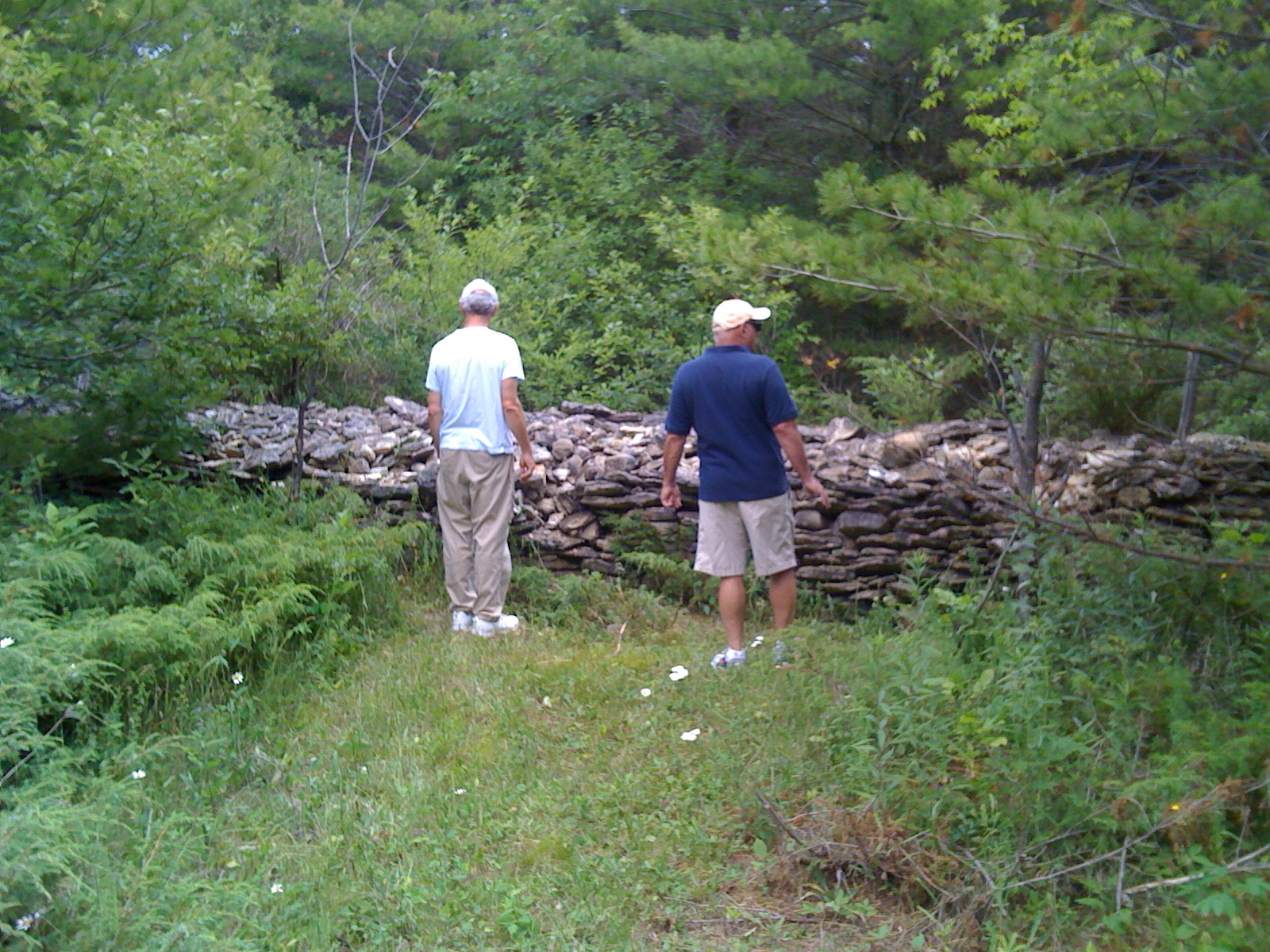
The Stone Wall – With Fossil Stones

The Ferry To Washington Island Through “Death’s Door”
We had a gender split where the ladies went shopping and the men went exploring. Our explorations took us to Northport, which is about the northern most point of the peninsula part of Door County. From there we observed the ferry that joins the peninsula of Door County to Washington Island. The six mile span of water between the two is known as “Death’s Door,” so named by the Indians because of the large number of canoes that sank there. Apparently the current and strong winds make it difficult to navigate. The door part of Death’s Door is the origin of the name, Door County. I guess they left the word “death” off for obvious reasons. :-) After Northport, we went to Gills Rock (Charlie’s Smokehouse) for some freshly smoked Atlantic Salmon. Yummy!
The next stop in our “guys day out” was Newport State Park, which gave us a view of Lake Michigan. We walked a hiking trail that provided us with views of moss, trees and the beach along Lake Michigan. We then took a bike ride through the northern tip of Door County that provided us with an up close view of where the local people live. That night, after a white fish chowder made by our host, Cyn, we did some star gazing with Andy’s Celestron Starhopper telescope. We “zeroed” in on the Northern Star and saw the milky way in a “milky way.” In other words, we saw why it’s called the milky way. :-)

Andy’s Celestron Starhopper Telescope

Sunset In Sister Bay
The next morning, Kathy and I were able to walk back to the Stone Wall without a guide. Yea! In the afternoon we went for a ride on Andy’s pontoon boat in Ellison Bay, which is a part of Green Bay which is a part of Lake Michigan. :-) That night Bill took us all out for a nice meal at Kristofer’s in Sister Bay. Our table looked out over Sister Bay; we had a wonderful view of the sunset while we enjoyed a delicious meal, giving us good taste through our eyes and mouth. AND, we had a Door County cherry-apple pie for dessert. Yummy, yummy!
Our last day, Friday, was a day of walking and resting. It was also our coldest day with the nighttime temperature around 50 degrees and daytime of 62 degrees. AND, no humidity. In fact, I wore a t-shirt and long sleeve shirt everyday. Wow! Last, but not least, I bought two pounds of freshly smoked salmon to bring home. It is good to eat for two weeks. Yummy!

View of the Cliffs of Ellison Bay from the boat

Beautifully Clear Green Bay – Lake Michigan
Confessions Of A Beginning Blogger
Posted on July 20, 2009 Leave a Comment
NOTE: This post was previously published on the St. Louis Bloggers Guild Site.

Sometimes I blog with pen.
I am new at blogging and thought that sharing my point of view might be helpful to those who are thinking about beginning, or who have “only just begun” a blog. On the other hand, these thoughts might also interest those who are thinking about giving up blogging or never even thought about it.
Actually, the word “interest” plays a big role in writing and reading blogs. Of course, I mean interest as it relates to motivation. One of the first things I discovered about blogging is that I must be interested and, therefore, motivated to do it in order to continue it.
Why blog? When I first started, this question was always in the front of my mind. My first answer was that I wanted to publish something that I had written. I have always had a desire to write and be published. In my previous life as a teacher, I tried more than once to write a textbook. I usually made it as far as the first chapter and quit. I could never make it past my own criticism. OUCH!
Earlier this year, I went to The Atlantic website and read an article entitled, Why I Blog, by Andrew Sullivan. That article, more than anything else, literally “set me free.”

Usually I blog with a computer.
Andrew Sullivan’s article “set me free?” Yes, and in many ways. You see, when I tried to write a textbook, I wrote using a prescribed “textbook format.” A format that is like the other textbooks and would be acceptable to a publisher. After all, if I write something like a textbook and a publisher will not publish it, then what?
About fifteen years ago, I spent a month writing a small pamphlet on time management. It was designed for use in a study skills course. I mention this because the writing of this pamphlet was successfully completed because I knew it would be published. The lesson here is that one reason I blog is because I know that when I want it to be published, it will be published.

I often blog while “on the go.”
From Mr. Sullivan’s article, I realized two important characteristics of blogging. I call them my “blogger FREEdom rights.” They are: (1) FREE to format any way I want and, (2) FREE to publish anytime I want. These two are powerful, in my opinion. Think about it. What newspaper, magazine, book publisher, newsletter, journal, etc. will allow a writer such freedom? I might be wrong, but I think none.
Now, my blogger FREEdom of rights are fundamental principles that I like and adhere to, but since I have begun blogging, I have come up with a few other “guidelines” that I strive to follow:
One is keeping a posting around five-hundred words. Why that quantity of words? Well, I’m not really sure. I think I feel like 500 is reasonable, but honestly, it doesn’t matter. That’s because 500 words just feels right and referring back to my first blogger FREEdom right, I can format any way I want. That’s part of my format. :-)
Another guideline is “writing for learning.” This means that when I blog, I am using it as a way to learn more about what I am thinking and also what I am capable of thinking about a particular topic. This is what I am doing at this moment. I am sitting in front of my computer screen and “confessing” about blogging.

I even blog while on holiday. :-)
Opps, I’m well over 550 words. If I’m going to follow my guidelines, then I need to stop.
Oh, one other thing. Bloggers love comments. I don’t know why, we just do! Please comment.
Why Plant Grass In Missouri?
Posted on July 15, 2009 3 Comments

My back yard, overall view.
A few days ago, as I was mowing the “grass” on my lawn, a neighbor stopped me and asked me about my lawn. Before I continue, let me explain why I put “grass” in quotes. I really don’t have much grass to mow. Most of what I mow is, well, weeds. Yes, what I mow, most would call weeds when referring to lawns. I do plant grass seed every Spring, but very little. Just something to fill-in the spots where the weeds, for some reason that season, won’t grow. Back to my neighbor – he asked about what I do to make the lawn look so good? Really, in my opinion, the lawn is not all that great. It’s just, well, covered and green. That’s all!
I don’t really take care of my lawn except to mow, fill-in a few gaps in early Spring and water & fertilize. But, watch out for the fertilizing. I did too much of that this year. It’s the first time that I overdid it in twenty years. Right now, as I write this, my “grass” is showing some “burning” from this fertilizer I used to make it look better. Ouch! Stupid me! I should have left well-enough alone.
So, what’s the point of the question, why plant grass in Missouri? When my neighbor asked me about the lawn that I was mowing, I said, “I don’t really do anything, but mow what I don’t want to grow.” He said, “It looks really great. I don’t understand; what do you mean?” It was his last statement that made me realize what I’m doing is not normal, at least, from his point of view. He didn’t understand my philosophy of maintaining a lawn in Missouri. What is that philosophy, you ask? The philosophy is: “Missouri is a green state. All you need to do is let it be green.”

Here’s a closer view of the same yard. Look’s good, doesn’t it?
You see, many years ago, I flew, for the first time, over the United States from Missouri to the West Coast. While flying over the west, I noticed all of the circular fields in the landscape. I asked the people seated next to me what they were. They all responded with the same response, “they are farmer’s fields that are irrigated.” In other words, they are green only because someone has provided water for the circular areas. “But, I wasn’t used to that in Missouri,” I responded. They said, “of course, you wouldn’t see that in Missouri; Missouri is a green state.” Ever since then, I have made that part of my philosophy for taking care of my lawn in Missouri.
Why should we be so concerned about our lawn in Missouri? Since it is a “green state” all we have to do is cut what we don’t want, let grow what we do and “fill-in” what is missing.
Simple, yes! complicated, no!

Here’s a “close-up view.” Notice there is little evidence of grass in the lawn. Only, what grows naturally in MIssouri.
Why plant grass in Missouri? Good question.
I would love to read any and all comments you have.
What Should A Math Teacher Teach?
Posted on July 13, 2009 1 Comment

A note to the reader: This posting is from a short essay that I wrote after retiring from full time teaching in 2000. Though it is dated, I think the message is still appropriate. I invite you to look at it from your point of view – which most likely is as a student, but not a teacher of math – and share your thoughts.
As a teacher, it is important to know what you are teaching. This may seem like a simplistic and obvious statement. I think many teachers do not completely understand what they need to teach. Teaching is often viewed as imparting or “giving” knowledge to students. Having taught mathematics for thirty-one years, I too had this view of teaching. I often, especially during the first half of my career, would see my role in the learning process as one who should give knowledge. I valued the demonstration of a good memory more than the understanding of a way of thinking. It is the improvement of the students’ thinking that I now value most. Of course, memory is important in the thinking process but it is only an aid to becoming knowledgeable. Memory can help when we need data, theories, concepts, etc. but it is not the only tool or aid that can help with our thinking. If we are not careful as teachers, we may “reduce” our teaching to expecting our students to perform and think as a tape recorder does. Does a tape recorder think? Does a tape recorder know?
The expectation of memorized thoughts and the need for answering all questions were my two main principles of teaching for the first half of my teaching career. This changed during the second half of my career when I realized that reasoning, problem solving, communication, and creativity are not improved unless the learner is taught to know without rote memorization and/or teacher answered questions. The beliefs that “rote memorization is the last desperate act for someone who does not understand” and “questions drive thinking – answers end thinking” became fundamental to all of my lessons.
So, exactly what am I teaching? What, in my mind, is my most basic goal as a teacher? This I struggled with for a long time. After thirty-one years of teaching and much research into different philosophies of education and human thought I have come to the conclusion that, as a mathematics teacher, I should teach the students how to improve their mathematical thinking. If I was a history teacher, I should help them to improve their historical thinking. This could and should be applied to all disciplines. Indeed, because each is an organized systematic way of thinking, we call the various “studies in school”, disciplines. They are disciplined ways of thinking.
What should a math teacher teach? To the best of her/his ability, teach the students how to improve their mathematical thinking. What should a student strive for in a mathematics class. To the best of her/his ability, learn what mathematical thinking is and how to make it part of her/his thinking.
What do you think a math teacher should teach?
Do You Ever Change Your Belief?
Posted on July 9, 2009 4 Comments

Do I believe or know that (some) roses are red? :-)
I was at a 4th of July Picnic recently and participated in a discussion about what beliefs are and whether a person should change what s/he believes. We weren’t long into the “discussion” before the topic of religion came to the forefront. Immediately, the discussion became more of an argument or debate. It seemed that the discussion of religion evoked a strong emotional response from almost everyone. This was especially true when I asked the question, “Do you ever change your belief?”
So, how would you answer the question? I don’t know about you, but I immediately said yes, of course I have and will change my belief. The instant I said that, there was an unbelievable response and not all of it was positive. There were some, especially those who admitted they are religious, that said they believed what their religion “said” and they would never change their belief(s). One person even said that he no longer believed what his religion taught, but he still believed it. Frankly, I found that statement to be really confusing.
So, if you really think your belief is not true, then why would you not change it? If you really believe something is true, then why would you want to change that belief? In fact, if you really believe something is true, then how can you possibly change that belief without being untrue to yourself? Wouldn’t you end up betraying yourself?
Socrates supposedly said, “be true to yourself.” As much as possible, I try to follow that “motto.” What we believe should not be fixed. We must be true to ourselves or end up living outside of reality. History is filled with examples of people not willing to change their beliefs in order to make what they believe fit reality. Examples like the “world is flat” and “the holocaust didn’t happen” come to my mind immediately.
I know some people have very deep and fundamental beliefs that they profess they would die for. Often times, these beliefs have to do with fighting for country, family or religion. In general, I am not talking about these types of core beliefs, since though we never know for sure, they usually can only be verified during “battle.” Having stated that, many of our beliefs are not matters of life and death, per se, with so much depending upon the beliefs. I use to believe in Santa Claus as a real live person who had the “gift” of being able to ride in a sleigh pulled by reindeers and deliver gifts to every home in the world. I no longer believe in a Santa Claus that has that ability. I changed by belief!
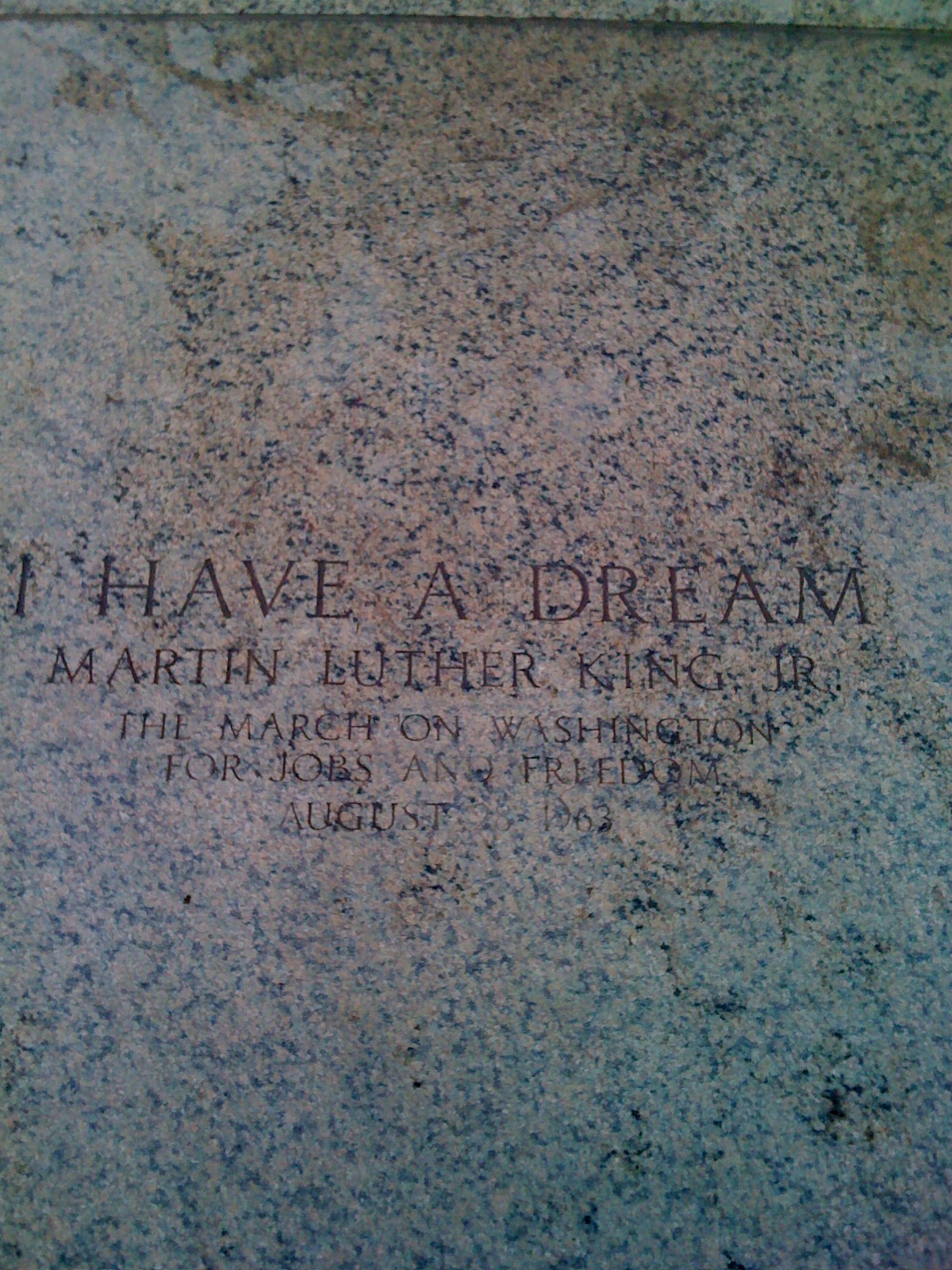
Dream and Belief, are they related?
In summary, I think most of our beliefs must be assessed like any other part of our thinking. If a belief is working for us by empowering us to be better people, then leave it alone. If it isn’t, then change the belief. There are many examples in history that reflect people who had beliefs that led to great success. Use those as a starting point and create a set of beliefs that makes you a better person. Simple, yes. Easy, no.
I “believe” a comment is in order. :-)


 R2 Thoughts for You