 R2 Thoughts for You
What Does It Take To Be A Creative Person?
Posted on November 19, 2009 1 Comment

I think, therefore I creatively paint!
Yesterday, my wife and I were walking and she made a comment about wanting to learn how to paint using watercolors. She also said that she has never been able to create a painting that is “good.” She said she is not creative!
I responded by saying that I thought creativity could be learned, and if one’s standards for painting were “lowered,” then anyone could create a good painting. I used examples of impressionism and cubism which, from my point of view, have standards that allow the result to not look like a photo of the model for the painting. Also, regarding one’s standards, I think the artist should set her/his own standards. This is especially true when the artist is creating for her/himself.
I think creative people are not born creative. In other words, I don’t think the nature part of us dictates our creativity, but I do think the nurture part plays a role. Children, that are raised in an environment that stifles their creativity by forcing them to live up to unreasonable standards, will tend to think they aren’t able to create art. They will not attempt to create and will exemplify the old adage of, “use it or lose it.” They don’t use their creative thinking and therefore, lose it.

Creating Creative Thinking!
Creativity requires us to use our creative mind. Think of it as a muscle. If you don’t use a muscle, it will become weak and eventually, will be unable to perform as it normally would. We all know that exercising our muscles make them stronger. The same is true for our “creative mind.”
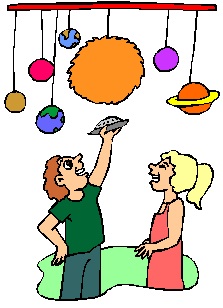
Here’s a creation representing our solar system!
So, what should we do in order to become a painter, musician, sculptor, builder, writer, cook, dancer, etc….? Well, one thing we shouldn’t do is nothing. The best way to become more creative is to create. Generate lots of ideas and decide, using your own standards, which ones to keep. Break a routine and do something differently. Generally, creativity means change and doing something in a different way.
So, what should we do if we want to paint a picture using watercolor? Get a brush, some watercolor and a surface to paint on and paint. Simple? Yes, if you can obtain the materials.
How do you become more creative? Exercise your creative mind!
How do you exercise your creative mind? One way is to get a brush, some watercolor and a surface to paint on and paint! :-)
Please create a comment!
Is Your Vision In Good Shape For The World?
Posted on November 16, 2009 Leave a Comment

A 1952 photo of a robot called “Sabor” frightening a baby in Hamburg, Germany
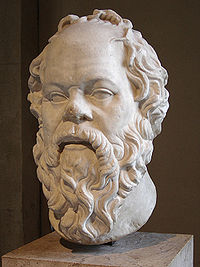
Socrates envisioned western philosophy
Do you have any problems with your vision? I don’t necessarily mean “vision” in the sense of seeing with your eyes. I’m talking about your vision that uses your imagination. The vision that allows you to “see” what you want the world to look like in the future. If you have such a “vision,” then what does it look like? Is it blurry or clear? Is it the way you want it to be and/or the way you think it will be? Is it a vision that allows you to be what you want to be? Do bigger dreams or visions generally mean big results?
The previous paragraph points out, in question form, some of the different ways we deal with vision. Many successful people have big dreams and have manifested those dreams or visions in various ways. Isaac Asimov, a popular science fiction writer from the twentieth century, had monstrous dreams or visions. He wrote over 300 books, wrote numerous short stories and won many awards while always manifesting a vision or dream that allowed him to go back and forth from fiction to non-fiction. When he wrote fiction, he very seldom expressed himself through a character that we might remember. Instead, most of his characters would be discreet, while allowing us to envision the story through their minds.

Da Vinci envisioned and lived the renaissance.
Asimov’s ability to have the reader see his vision was powerful. Through his writing, one could see into his mind. At least, that is the way I felt as I read some of his books. I remember reading, “I Robot” while in high school and then later on, seeing films based on some of the short stories from the book. Asimov’s vision and the vision I had in my mind regarding robots, were one and the same. Of course, my vision was most likely strongly influenced by his writing. That alone was great, but after I saw a short story from the book portrayed on the movie screen hosted by Boris Karloff, I realized how good Asimov was at clearly revealing his vision to us. The screen version was almost identical to what I had in my mind.
Of course, most of what I read from Isaac Asimov was science fiction, yet he wrote in such a way that my friends and I felt it was real and we understood it. He wrote from a point of view that all could understand science. That was a big vision.

Einstein envisioned a different order for the universe.
People who have big visions have had great impacts on civilizations. Examples like Socrates, da Vinci and Einstein come to mind. Socrates for his vision of a Western Philosophy, da Vinci for his Renaissance vision and Einstein for his special vision of physics.
We also have had people whose visions were negative. Hitler comes to mind almost immediately. He had a grandiose vision, but from my point of view, it was an irrational model for our society. His New Order was a vision that excluded many people for reasons of birth, relationship and/or ethencity. It was a vision that wasn’t good for a world that is as diverse and rational as ours. Again, Hitler’s vision was wrong for our world, but was somewhat a reasonable vision, if applied to, for example, animals in a zoo.

Hitler envisioned a world of exclusion.
So, what kind of world would you like to see in the future? I believe your vision for the world helps shape your life. It helps give you purpose and a sense of accomplishment.
We need to create a vision for our world that, unlike Hitler, is inclusive, fair-minded and positive. It should be a vision that enables all of us to contribute toward the improvement of everyone in our world. It should be a vision that helps our world be in “good shape.”
What’s your vision?
Should We Be Rational?
Posted on November 12, 2009 Leave a Comment

Engraving of portrait of Greek philosopher Xenocrates (396-314 B. C.), disciple of Plato and the first to divide philosophy into logic, physics and ethics, from “Diogenis Laertii de Vitis, Graeci et Latine” by Marcus Meibomius, 1692.
Should we be rational and/or logical? Recently, I heard a discussion about rationality and how we overuse it. In that same discussion, the words “rational” and “logic” were interchanged. Those that were participating in the discussion were treating the two words as synonyms. I don’t believe they are and that treating them as synonyms causes more confusion than clarification.
OK, so what do I think is the difference between the meaning of the words, rational and logic? Please, read on.
Rational, to me, ideally means thinking that is not egocentric and is done in a systematic manner where the thinking is taken apart, assessed using good intellectual standards and strives toward good intellectual traits. It is difficult to give a short and clear definition of rational, but easy to say what it isn’t. It isn’t thinking that’s unfair, egocentric and unsystematic.
The word logic is used in many different ways, but to me, it means thinking in a way that “makes sense.” It means thinking that consist of parts that “fit together.” It means thinking that is supported by evidence. In other words, logic is more of a standard used to assess thinking and rational is a way of thinking that uses logic as one of its assessment standards. The internet is full of different meanings for rational and logic. For this discussion, I will use the description given at the beginning of the previous paragraph.
Social science research has shown that most of the time we do not make smart, rational choices about our health, money and love life. Some of us will complain about a 5¢ overcharge and then walk to a coffee shop and pay $5 for a latte. Many will avoid going to see a doctor or getting medical tests that would help detect common killers, while at the same time have a religious fervor for daily exercise. We do the exercise for living a longer and healthier life, yet make choices to avoid detecting a problem that will shorten our life. These choices that go against our self-interest are not rational. Since, in a way they don’t make sense, I guess our choices aren’t logical. :-)
It is difficult to always be rational. It’s hard to separate our emotions from our rational thinking. Our mind is capable of doing so, but we often intuitively make decisions without consciously realizing that the decision was made on pure emotion. Before we can correct this way of thinking, we need to make ourselves aware of when it most likely will happen. In my case, I tend to be less rational when I don’t have enough time to think about the decision. I feel rushed and my decision is often based on “how I feel about …” and not on “how I rationally thought through the problem.”

Do you promise to be rational?
I must admit that often times a decision, which is made fast and based on feelings, turns out the be a good decision. That’s good and bad. It’s good in that the final result was good. It’s bad in that the method for deciding, resulted in reinforcing irrational thinking. It’s also bad because when we make decisions in this way, the method can be habit forming due to receiving instant gratification. In other words, “we had gain with no pain” instead of “no pain, no gain.” In my case, I know I need to spend more time thinking about my choices and looking at problems from a rational point of view. I need to find a way to “not hurry” and “not emote” when faced with a major decision. This will help me to not base my decision on my feelings and instead, be aware of my feelings while I look at the problem rationally.

It’s not logical, but I love you!
Before I end this, I think it is important to emphasize that no one can always be logical. Of course, if we use logic as a standard for assessing our thinking, and not as a “way of thinking,” then we should have no problem with logic.
Often times, human relationships defy logic. In other words, sometimes relationships just don’t make sense. They are not logical. My Mom and Dad are an example. From my perspective, they were opposites. They didn’t seem to have any common interests, yet their relationship was “successful.” It wasn’t logical but it was rational. They had a system (relation) that worked for them. I think their relationship wasn’t logical, but it was clear, relevant, accurate and significant with breadth and depth. These are all standards, like logic, that can be used to help rationally assess the relationship.
In summary, I think we should, as much as possible, look at our life through a “rational window.” It doesn’t mean we will use only logic. It doesn’t mean we won’t have feelings. It doesn’t mean we will be boring. It means we will strive to be our best.
Should we be rational? YES!
Is A Mistake An Enemy, A Friend Or A Teacher?
Posted on November 9, 2009 1 Comment

Make no mistake, I’m your enemy!
Do you ever make a mistake? Of course you do. Who doesn’t make a mistake? No one! Are all mistakes alike? Of course not. So, what does a mistake mean to you? Would you say a mistake is like an enemy, a friend or a teacher?
The questions in the above paragraph are all about mistakes. We make all kinds of mistakes. Some mistakes are small, like mispronouncing a word, and some mistakes are big, like the sinking of the Titanic in 1912. Most people try to limit their mistakes and limit is all anyone can do. We cannot entirely eliminate mistakes from our life. Since we can’t eliminate them, then what should we do about the inevitable fact that we will make mistakes? Treat them as a type of person. What does that mean? It means, metaphorically, treating them as a person we can learn from. Ok, so how do we do that?
First of all, we generally dislike mistakes. They cause us to be confused and embarrassed. Mistakes often lower our self-esteem. But, as the old saying goes, s**t happens and so do mistakes. Yes, they happen and they happen to be a regular part of life. But, if we view them as people, then we could think of each mistake as an enemy, a friend or a teacher. Which would be best? Let’s think about how we deal with each.

Should mistakes be treated like friends?
Our enemies are people that we generally avoid. Treating a mistake like an enemy has merit in that we want to avoid it. But, as stated before, we will always make mistakes. Unfortunately, we won’t be able to completely avoid mistakes, so treating them as enemies only sets us up for failure. We will end up spending our time avoiding instead of facing and solving our problem of making the mistake.
Our friends are people that we generally like and want to be with. Treating a mistake like a friend also has some merit in that we are now facing our problem. But just “befriending” our mistake doesn’t necessarily give us the tools to avoid it in the future. Instead, by “befriending” the mistake, we are encouraging it to occur again. Ouch!
Our teachers are people that we learn from. Treating a mistake like a teacher, allows us to take a negative and turn it into a positive. When we make mistakes and treat them like teachers, we will find they are very demanding teachers. Like a demanding teacher, we will reassess our goals, look at different points of view, retrace our steps, repair any damage and reflect on the lesson learned. Perhaps, the most important result is allowing the mistake to become a lesson learnt.

Treat your mistakes like you treat me!
Is a mistake an enemy, a friend or a teacher? A Teacher, of course!
Help me with my mistakes by making a “teaching” comment. :-)
Do Problems That Are Avoided Require No Solving?
Posted on November 5, 2009 1 Comment

Nixon’s problems portrayed on the cover of Time magazine, Aug. 27, 1973
“Please, if you are unsure of what to do, ask me. It’s generally easier to avoid a problem than solve a problem.”
Recently, my granddaughter was at our house and she asked me if she could use the computer to print a resume′. I responded with a yes and then followed with the above quoted statements. The minute I said them, I thought to myself, “where did that come from?” I made the statements, yet I don’t remember having thought seriously about how the avoidance of a problem is easier than solving a problem.
Of course, I am aware of statements like the one from Benjamin Franklin – “an ounce of precaution is worth a pound of cure.” Franklin’s statement is closely related to the one I made, but tends to be directed more to health problems.
So, how can I put my statements together and have it as short and precise as Benjamin Franklin’s?
Benjamin Franklin – “Curing Problems”
“Avoiding a problem is usually easier than solving a problem.”
“To avoid or to solve a problem, which is better?”
“Avoiding problems is better than solving problems.”
“Avoiding a problem – no problem, solving a problem – a problem.”
“An ounce of avoidance is worth a pound of solution.”
“Problems that are avoided, require no time solving.” I think I like this last one. It’s definitely short and says no more, or no less than what I wanted to say to my granddaughter.

TIME cover 07-13-1998, knotted stethoscope used to symbolize problems in the health care industry.
“Problems that are avoided, require no time solving.” Is the statement true? Absolutely – we don’t have to solve a problem that doesn’t exist, or do we?
Is there ever a situation where we solve problems that don’t exist? I don’t know about you, but I’ll admit that I do worry sometimes about problems that don’t exist, and yes, I spend time thinking about their solutions. In fact, now that I think more about it, I have spent a lot of time solving problems that don’t exist. For example, last Summer I was concerned about what to do if a hurricane would threaten our vacation on Hilton Head Island. I, in my mind, began solving the problem by considering where we would stay inland and “ride the storm out.” Keep in mind, at the time I was solving the problem, the only hurricane that existed was in the Pacific Ocean and Hilton Head Island is in the Atlantic. What was I thinking?!!!
Ok, so should we spend time solving problems that don’t exist? No, if it is a problem as exemplified in the previous paragraph. But, yes, in the spirit of using our thinking to imagine implications and consequences of actions that we might take both physically and mentally. In that sense, we might be wise to spend time solving the different problems that we imagine in order to see which action(s) we should take. An example of this kind of problem-solving is experienced when we play chess. Another example is when we have a “brain-storming” session.
So, is the statement, “Problems that are avoided, require no solving,” still a worthwhile one with a good message? I think it is, provided it is used as a guide and not as fundamental principle. Metaphorically, it’s like a good teacher who is the “guide on the side and not the sage on the stage.”
What do you think about avoiding problems instead of solving them?
What Does It Mean To Be Genuine?
Posted on November 2, 2009 1 Comment

Genuine Advertisement?
Are you “your own person?” Are you “for real?” Are you genuine? On numerous occasions, I have observed people trying to impress or control others. At the same time, these same people were usually not revealing who they really are. For example, recently I saw a person who I know has medicare, boasting that he would never trust a government-run health insurance program. When I pointed out that Medicare is a government-run health insurance program, he denied knowing that it was run by the government when he signed-up for it. I then asked him if he was happy with Medicare and he said yes. He then proclaimed that he had heard on Fox News that he should never trust a government-run health insurance program so “that’s that.” Is he genuine? I don’t think so!
How can we be “genuine” and not be aware of what we are really thinking and/or feeling? Carl Rogers once said, “The curious paradox is that when I accept myself just as I am, then I can change.” When the before-mentioned person talked about never trusting a government-run health insurance program, I don’t think he was honest about his own thinking regarding the subject. He was not expressing what he thought, but instead, what someone on Fox News said. He was not, in my opinion, genuine.

Genuine Love?
Genuine people are aware of their thinking and feelings. They see no need to act like someone they aren’t. They know their weaknesses and strengths. Genuine people know that knowing and accepting something isn’t the same thing as liking it.
Personally, I know I have many faults and I’m usually not afraid to admit them. That doesn’t mean I like my faults. I am constantly trying to improve while at the same time, trying not to be a hypocrite by “putting on an act” in order to impress someone. Of course, I have been guilty of being a hypocrite now and then, but I never purposefully continued that behavior after I recognize it.
So, what does it mean to be “genuine?” Using the idea behind the quote from Carl Rogers, a genuine person is one who accepts her/himself for what s/he is right now and right here. Once that happens, then change is much easier. Therefore, if you are not happy with who you are then you shouldn’t worry about it.
Accept yourself and then change. Don’t pretend to be what you aren’t. Be genuine and you will be genuinely happier with yourself! :-)
How Should We Approach Complex Problems?
Posted on October 29, 2009 Leave a Comment

How should I solve this complex problem?
Let’s say you have a real difficult problem to solve. Suppose it’s difficult due to the complexity of it. In other words, suppose the problem isn’t something like, deciding what pair of shoes you should wear, but instead, involves a decision about which medical procedure you should have in order to cure a serious medical problem. How do you approach such a complex and serious problem?
In my case, one of the problems I have to deal with first, is removing the pressure I feel for having to solve the problem. To avoid the pressure I feel when I’m faced with such a problem, I will push hard to solve it. When I do so without bringing in a large amount of patience, I often end up just “spinning my wheels.” Now, in a way, I “over-think” the problem. You see, I will look at the problem from every possible angle. I’ll collect as much information as I can – always, as quick as I can. I then, in my opinion, over analyze the problem considering the amount of time I spend in trying to solve it. So, how should we approach these complex problems?

No time for intuition!?
I think the first thing to understand is that we generally, as humans, have a low tolerance for confusion. We want an end to confusion and have immediate certainty. This is what we want, but is this the attitude we should have when dealing with complex problems? Absolutely not!
Of course, we want resolution. Of course, we want clear answers. But, how can we demand solutions to complex problems and place unneeded time frames for resolution? We can, but we shouldn’t. Here’s my problem for solving complex problems, as I see it. I think I over-analyze it and end up being surrounded by the problem and unable to see different points of view, implications and/or consequences. I become immersed in the problem and not the solution.
We should always collect all relevant information and focus on the problem. Having stated that, I think we should also “step back” from the problem and trust the creative part of our thinking to help us with the solution. There is a creative, subconscious part of our mental make-up that we need to know is always there, even though we aren’t consciously aware of it. We use it, for example, when we drive a car, when we decide on the amount of spice in our meal or when we choose a friend. These examples might use analysis, serious deliberation, different perspectives, etc., but they also usually involve a creative part of our thinking that comes from a different and “unconscious” part of our mind. That is an important part of our thinking that we should bring into our approach to solving complex problems.

Creative thinking at a “snail’s pace” might help.:-)
So how should we approach complex problems? We should not ignore concrete information. We should not ignore analysis. We should consciously add the “subconscious intuition” with analysis. It’s this subconscious part of our thinking that is an important partner with analysis and helps us do our best creative work. When solving any problem, including complex problems, we need to use creative thinking. We must create a solution. To create a solution, doesn’t it seem reasonable to use creative thinking? Turn your thinking loose!
What do you think?
What Does It Take To Really Commit?
Posted on October 26, 2009 Leave a Comment

The three men who committed to developing the Explorer 1, America’s first Earth satellite which was launched January 31, 1958. At left is Dr. William H. Pickering, former director of JPL, which built and operated the satellite. Dr. James A. van Allen, center, of the State University of Iowa, designed and built the instrument on Explorer that discovered the radiation belts which circle the Earth. At right is Dr. Wernher von Braun, leader of the Army’s Redstone Arsenal team which built the first stage Redstone rocket that launched Explorer 1. The three men held a model of Explorer 1 over their heads the night the satellite–the U.S.’s first–went into orbit, four months after Sputnik.ID: GPN-2000-000478 Other ID: P8485 Credit: NASA Headquarters – GReatest Images of NASA (NASA-HQ-GRIN)
What do you do when you really commit to something? Do you give only “lip service” when you commit? Do you “talk the talk, but not ‘walk the walk’?” What does making a commitment really mean? Does making a commitment really matter?
The previous paragraph offers many questions regarding commitment and your point of view about it. I think we all have a deep need to be involved with others — indeed, a need to be involved in the world. The proof of this fundamental human need is constantly demonstrated by history. Consider how we humans have populated the earth, or how we explore/investigate every aspect of life. Consider how we continually invent ways to be connected, from beating a drum to beating the virtual keyboard on our iPhones. Consider how we went from posting pictures on cave walls to now, posting pictures on the internet. The point is we, as a human race, want to be involved in our world.
We also show our need to be involved by our desire for social and/or close relationships. We want “what we do,” to count for something. We want to feel valuable in life. We want to feel connected in a way that we are important to the connection.
So, what do all of these wants and/or needs have to do with commitment? Well, the commitments we make are often the results of wants and needs. In fact, I think we usually commit ourself to something that starts in our mind as a want/need. I know that you might be saying to yourself that you commit to many things that you do not desire or want. Perhaps the desire or want may not seem to you, on the surface, to be the reason, but underneath, your reason is a desire or want. Consider a parent who is committed to taking his children to an amusement park. S/he may take them, not because, “on the surface,” s/he wants to personally, but because s/he thinks that such a family outing would be a desirable thing for the family. Since s/he thinks it is good for the family, then s/he wants and/or needs it.
Commitment is a need or desire that we must enter into a relationship with! When we make a commitment, we should never count on gaining anymore than we are willing to put into it. Actually, we should make a commitment without hoping to gain anything. Commitments are actions of giving and not receiving. What we gain from commitments is equal to what we are willing to put into them.

Is this a sharing commitment?
Deep commitments, like marriage, allow us to discover who we are as individuals. From our deep commitments, we grow to our fullest. It’s our deep commitments where we give freely to others. Consider how freely a committed teacher gives to her/his students. Commitment is not just a matter of thinking and speaking. Commitment is something you must do in the present. It is something you must not only, “talk the talk,” but also “walk the walk!”
Do you have a comment on “commit?”
Do We Really Have A Choice Under America’s Current Health Insurance System?
Posted on October 22, 2009 Leave a Comment

Dr. Yu
On Tuesday, October 13, my wife and I attended a seminar hosted and presented by Dr. Simon Yu, MD. He is the founder and resident doctor of Prevention and Healing Inc., located in the suburbs of St. Louis, MO. At this seminar, Dr. Yu gave a presentation that was a repeat of one he gave the previous weekend at the Sixth International Medical Conference – Bio-Cybernetics & Energy Medicine The Vital Links to Vibrant Health. My wife already knew Dr. Yu and she encouraged me to attend. Every month, he offers a free seminar which is open to the public. I found the environment to be friendly and welcoming at the one I attended on October 13.
I have always thought I should be responsible for choosing my medical care provider(s). Since Dr. Yu practices the use of “alternative” medicine, his seminar gave me an opportunity to explore non-traditional medical care. Of course, non-traditional medicine is often in the “eyes of the beholder.” Many different places in the world would consider our traditional medicine to be non-traditional.

A toast to our health care system!
The seminar was interesting and enlightening. It was an “eye-opening” experience for me. Dr. Yu explained how, using modern science and old traditional medical concepts and techniques, he is able to truly follow the old medical adage, “do no harm.” He also focuses on the whole body while treating his patients. The seminar was well-attended with a diverse group of people that seemed, from the questions they asked, to have different and serious health concerns that weren’t being addressed by “regular” doctors. I used “regular” in the previous sentence because Dr. Yu practices complementary and Alternative Medicine in addition to doing what a “regular” internist does.
OK, so why the title, “Do we really have a choice under America’s current health insurance system?” My wife and I have expensive health insurance that does not pay for visits to Dr. Yu’s office, the expense of his evaluation methods nor most of his prescribed medicines. I mean the insurance doesn’t pay in the sense that the company doesn’t approve of him or his methods. It has unreasonable deductibles that must be met before an extremely small percent of the bill is payed to us as reimbursement.

Your choice is: “Take this or nothing!”
Using our current health insurance, if we would like a second opinion and the insurance company approves it, then we must get that opinion from a source that most likely thinks and practices medicine similar to the first opinion. The second opinion will often times be based on a new test, but that test will be done in the same manner as the first. Therefore, the results will most likely be the same unless the first test was somehow flawed. What we really need is not a second opinion necessarily, but instead, another point of view. Our insurance doesn’t value different points of view. We are encouraged to have tests, see doctors, purchase medicine, etc. based on what the insurance will pay for. Of course, if we can afford it, then we can pay the premiums required by the insurance, have them pay as much as they will toward our health care and we pay the rest.
Where is our choice? We choose from a list they gives us. We choose from a list of pharmacies that the insurance company gives us. We choose from a list of labs that the company gives us. We choose from a list of …….. Instead of choosing from what is best for us, we are choosing from a list that allows the insurance company to make a higher profit. At least, I think that is why the insurance company won’t allow us our choice. Why doesn’t the insurance company allow the patient to choose any doctor, then pay the same amount, no matter what doctor is chosen?

Stephen Hemsley made $3 mil. in 2008 and is helping me with my choices!
One last point. My wife and I have UnitedHealthCare Insurance whose parent company is UnitedHealth Group. The CEO of UnitedHealth Group is Stephen Hemsley. Last year his total compensation was $3,241,042.
Do you choose to make a comment?
Do You Believe Your Compliments?
Posted on October 19, 2009 Leave a Comment

You are such a good worker!
What is your usual response when you receive a compliment? Is it the same response you have when you receive criticism? I know people often have trouble receiving, or should I say, accepting criticism. I did a posting on criticism last March and discussed whether or not criticism is good. At the end of the posting I made this statement, “So, is criticism good? Yes, provided it is given and received in a positive manner.” In a sense, I think that we could replace criticism with “a compliment” and also have a meaningful statement.
So, how well do you receive compliments? Do you receive them in a gracious and thankful manner? If you want to empower yourself and raise your self-esteem, then how you receive a compliment is important. I have given compliments to many people who have responded with a statement that was, more or less, a put-down to them. They often make me feel like it was foolish for me to compliment them. They make me feel like the compliment wasn’t deserved and that it was foolish of me to make such a positive statement. Really, in my opinion, they put themselves down. Why?

You’re really looking good!
So, specifically, what am I writing about? Well, suppose I compliment someone on how nice their hair looks and s/he says, “It’s so humid today that my hair looks frightful.” How about when I say someone did a great job on “whatever,” and s/he says, ” Oh, I was just lucky, it was nothing.” Or, if I say, “Your house looks nice,” and they respond with, “I really haven’t had time to do anything to it.” What do these statements tell me? I think they reflect someone who is confused with the concept of humility and denigration. Denigration of oneself, that is!
We should be able to accept a compliment in a way that doesn’t make the person who is giving it feel insulted or foolish. Of course, there are times when someone gives a compliment and doesn’t know all of the extenuating circumstances. I think, generally speaking, these undeserved compliments are not worth making a “fuss over.” You see, when we reject someone’s compliment, we are really rejecting them. At least, we are rejecting their support. We are rejecting her/his expression of kindness. We are rejecting her/his opinion. In a way, we are rejecting her/him. Ouch!
When we accept the compliment, we show respect and love for ourself. When we accept the compliment, we show belief in the person who gave it. When we accept the compliment, we enhance the self-image of the giver and ourself. So how should we accept a compliment? There is no set way, but if you’re unsure, then a “Thank-you, smile and sincere look,” would never be the incorrect way.

You are a very good person!
Accept your compliments the same way you accept something you desire, with thankfulness and gratefulness.
I’m grateful, in advance, for your comment.


 R2 Thoughts for You