 R2 Thoughts for You
Ethos, Pathos And Logos – My Personal Greek Odyssey
Posted on April 5, 2009 1 Comment

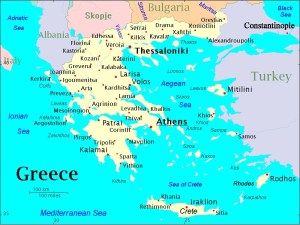
Fifteen years ago, during the Summer of 1994, I spent three weeks in Greece with my wife and brother-in-law. My wife and brother-in-law are of Greek ancestry. We drove through much of Greece, spending a lot of time with Greek friends and family. I am not of Greek ancestry and not able to speak Greek. My wife and brother-in-law can speak some Greek and the friends we were with, were fluent in both Greek and English. I mention all of this in order to establish what my visit was like, from my point of view. You see, I always had someone with me who could interpret the language, therefore, allowing me to follow my “intellectual curiosity” to wherever it may lead.
One of the more important traits of Greeks that my curiosity led me to was the way they judge people. Now, I don’t mean “judging legally” or even, “judging socially,” but instead how they, in general, seemed to judge one’s essence. They, the Greeks we met, would view me, first, as an unknown quantity and quality. I would notice how they would spend a lot of time observing me, asking about me and listening intently to what I said, of course, usually through an interpreter. After a couple of weeks, I happened to come across a essay, written in English, that shed some light on what I was experiencing.
The essay was about ethos, pathos and logos, but was not, necessarily, about the ways to persuade using language. Having stated that, I should point out that there is a connection, in that, ethos (character), pathos (emotion or passion) and logos (logical reasoning) are the three forms of persuasion used by Aristotle; the Greeks that I met were using these three “paths” to judge me.
OK, so what do I mean? In order to keep this as simple and clear as possible, I am going to explain what happened to me and how I viewed my experience.
My experience was that they, the greeks, didn’t regard the importance of my intelligence or passion, as much as my character. They would literally search for traits and features that made me who I am. Their questions would often be about my history and how it reflects what they were observing. A specific example is how they questioned our friends about my drinking a glass of wine without eating food. They consider it barbarous to drink without eating. They questioned my apparent lack of good character regarding the act of drinking without eating. But, the important point to make, is they didn’t judge without questioning. I often find that, in America, we are quick to label someone as good or bad, while only observing their passion or perceived intelligence.
Fifteen years ago, in Greece, I learned a valuable lesson of life. When considering the merits of a human being, start with ethos (character) and then consider pathos (passion) and logos (logic or intelligence).
What are your thoughts about this?
ETHOS
PATHOSLOGOS

Do You Know Your Purpose and Worth?
Posted on April 2, 2009 1 Comment

For the last nine years, I’ve had a fundamental question in my mind. What is my purpose? In other words, does my life have an important purpose? This question arose quite unexpectedly. You see, I retired nine years ago and before that, my purpose, though not explicit in my mind, was my profession. Before my profession, my purpose was being a student and preparing for the profession. But when I retired, I discovered that I was confused about the apparent lack of a “sense of purpose.” I remember telling anyone who asked what retirement was like, that I found it most difficult to find a sense of purpose. I guess I had never thought purposefully about purpose until then. “Purposefully about purpose” – I love that statement. :-)
OK, so what is my purpose, now that I have had nine years to think about it? That’s still a good question. I want my life to have an important purpose, and I am the only one who can determine what that purpose is. Looking back on my life, I now realize that I sincerely believed, that being a good teacher – my profession for most of my working life – was an important purpose. So now, what is my purpose? I didn’t realize before retirement, that I would need to rethink my purpose when I retired. When I bring up this issue with fellow retirees, I often get a confusing look. Some, if not all, seem to know what their purpose is, OR they don’t think it is important enough to even consider.
Before I go any further, I should point out a possible point of confusion. I have often confused purpose with worth. I now realize, that it is important to NOT look outside of yourself for worth. At the beginning of my professional career, I would often judge my worth by how well I was doing in my profession. That, as I see it now, was a mistake. When we look outside ourselves to feel worthy, we are creating a dilemma where we must constantly work for approval, acceptance, control and yes, even love, in order to feel worthy. We then make our self-worth dependent upon a career, an income, our appearance, our family, our neighbors, and the list goes on and on and on ….. If we lose our job, or our appearance (due to looking or feeling older), or our family grows older and moves, or our neighbors move, then there goes our worth. Hopefully, you can see where I’m going with this; your worth must come from your inner self. In fact, we all have an inner value, and it is there for each person to find for her/himself.
I believe a sense of purpose helps me live a more satisfying life. It is important for me to give meaning to what I do and NOT for what I do to give me meaning. Therefore, what is my purpose? My purpose is almost the same as it was before I started my profession — to be a student that is preparing for tomorrow.
Have you ever had, or are you currently having a problem with purpose or worth? I’m interested in what you think.

Do You Think “It” is good or bad?
Posted on March 30, 2009 1 Comment

First of all, let’s make it clear that “it” is not “information technology.” “It” is just the pronoun that refers to, “whatever,” using the lingo of today. :-)
According to Shakespeare, “Nothing is good or bad, but thinking makes it so.” So what makes something good or bad? Is it really just what we think? Probably so. Think about it — if I have a “bad” day, does that mean that all have a bad day? Of course not. The more I think about it, the more Shakespeare seems to be correct. What’s good or bad seems to depend on what I think is good or bad. Wow!
If what I am wearing is ugly, then every single person I asked should say, “Yes, that’s ugly.” But, what are the chances that will happen? Slim to none. If I am having a “bad day,” what are the chances that everyone is having a bad day? Again, slim to none. Not to over do this, but even if two people share the same experience, what are the chances they will recall it in the same way? Yep, you guessed it, slim to none. So what are we to do with the fact, that it is only what we think, that makes something good or bad?
I think we are capable of taking charge of our thinking. If what I think has any validity, then we should be able to change our thinking regarding any of the “its.” We should be able to look at something from different points of view and literally make “lemonade from lemons.”
In order to do this we must, first, believe that it is possible. What I mean is that you must believe it is possible for YOU! After you believe it, then you must try it. As my father-in-law often said, “actions talk, bull-shit walks.” And, if you don’t have the desired outcome, then what should you do? Try again! And, again! ETC…..
The more you try, the better you can get. Come on, let’s be honest with ourselves — if you continually try something, don’t you get better? Really, if you are really honest with yourself, “practice does make perfect.” OK, not really perfection, but improvement, yes?
If you continually work to improve, then you have a good chance of getting better. One day, you will say to yourself, “I don’t remember when I was not this way.” I know, I know, it is easy to say this, but very hard to do it. True, but just because it is hard, that doesn’t mean we shouldn’t try.
That’s what I think, what do you think?

Blogging, St. Louis Diversity and The St. Louis Bloggers Guild
Posted on March 27, 2009 3 Comments


St. Louis Bloggers Guild
Let’s start this posting with a little personal history about my blogging. In December of 2008, I was at a holiday party where I asked the question, “Why do you think people blog?” I also announced that I was wanting to start a weblog, aka, blog. I told them I was interested in writing for learning. I also thought it would be helpful in improving my thinking skills. I have written about this in past blogs, the most recent entitled, My Writing, Dementia and Mother.
A few days after the above mentioned holiday party, I received an e-mail from one of my friends who was at the party. She sent me the URLs for the websites of Andrew Sullivan’s, “Why I Blog” and The St. Louis Bloggers Guild. That was a helpful gesture, in that it enabled me to see many different perspectives about blogging. I first read Andrew Sullivan’s discussion of “Why I Blog” and then read some of each blog listed on the St. Louis Bloggers Guild site. I should also mention the help that I received from a Kansas City friend. She is my son’s friend and it was through their friendship that I first met her. She had started a website entitled, Dog-Eared Pages, of which I enjoyed her clear and succinct writing. Last Fall, October, 2008, I started reading her blog, entitled Dog-Eared Pages Weblog. It was her blog that precipitated my interest for writing my own blog. Thanks Sarah! It has been, and still is, a rewarding and fulfilling experience.
OK, so what are my thoughts about the St. Louis Bloggers Guild? I found the Guild and all of the members’ sites to be insightful, resourceful and diversely interesting. As mentioned above, I first went on the Guild’s site and read some of each members’ site. That enabled me to see what other local bloggers were doing and, more importantly, how they were doing it. I then created my own blog taking into consideration what I liked and disliked regarding the research done on the St. Louis Bloggers Guild site. After blogging for three months, I applied and was accepted as a member of the Guild. I am proud to be a member and hope my addition to the Guild only increases the “insightfulness, resourcefulness and diversely interestingness” of the organization.
You most likely know that St. Louis is no longer one of the biggest cities in America. So what? We are a large metropolitan area AND we are diverse. We are located in the center of the continental United States and are still considered to be the Gateway to the West. We have a national monument called the Gateway Arch. We have a diverse population, diverse weather, diverse terrain, diverse politics, diverse ideas, diverse etc., etc., …..
So what’s my point? Well, in my opinion, not only are we, in the St. Louis area, central geographically, but also “central” in diversity. I think our Gateway Arch could easily be renamed the Gateway To Diversity Arch. Now, I know there are a lot of people who don’t agree with me, but this is not about agreeing; it’s about being tolerant of differences – diversity. And, tolerant of different blogs. The St. Louis Bloggers Guild DOES have different and diverse blogs!
What are your diverse thoughts about our diverse arch and/or city? :-)
A “tip-of-the-arch” to the St. Louis Bloggers Guild. Thanks for accepting my membership.

How Can I Be Happy?
Posted on March 25, 2009 4 Comments

(-: Today, let’s talk about being happy. :-)
I assume everyone wants to be happy. At least, all sane, clear thinking and realistic people do. Again, this is my assumption.
Before we go much further into this discussion, exactly what is happiness? Most likely, happiness is, “in the eyes of the beholder.” Some people think happiness is getting everything they want. They want cars, furniture, vacations, clothes, etc.. More often than not, this can lead to never being happy. Every time they get something they previously wanted, their happiness ends with the “newness” of their acquisition. This means happiness is always in the future. It is always coming and going in their life – always appearing and disappearing, therefore, leading to a never ending search for happiness. No matter how much is acquired, there is never enough.
Consider the following quote:
“There are two things to aim at in life: first, to get what you want; and after that, to enjoy it. Only the wisest of mankind achieve the second.” ~Logan Pearsall Smith, Afterthoughts, 1931
“To get what you want” is what I was referring to at the beginning of this post. If we achieve happiness, then, at the best, it is temporary. But, if we “enjoy it,” where “it” implies the object of our proposed happiness, then we are developing the wisdom to enjoy the things we have.
My point here, is that we should always strive to enjoy what we currently have. There is beauty to be appreciated in the simplest elements of life. No matter how bad our life is, we can find many reasons to feel joy on a daily basis. New things will give us some happiness, but relationships (for example, love of a spouse), simple pleasures (for example, a warm slow bath), nature (for example, watching a robin build a nest), positive actions (for example, cleaning your environment) will lead to real and lasting happiness. In other words, we need to find our happiness in the life we have and not keep thinking happiness will find us in the future!
Who should be happy? – YOU!
When should you be happy? – NOW!
Where should you be happy? – HERE!
Why should you be happy? – LIFE!
How should you be happy? – CONSIDER THE PRESENT A PRESENT!
These are my happy thoughts. I would love to hear about yours.

Spring Has Sprung – Spring Potpourri!
Posted on March 22, 2009 Leave a Comment

As the title of this posting implies, this is a mixture of thoughts about the season of Spring. I have always found this time of the year to be up-lifting. Hopefully, the “potpourri” provided here will put some “spring” into your step. :-)
For winter’s rains and ruins are over,
And all the season of snows and sins;
The days dividing lover and lover,
The light that loses, the night that wins;
And time remembered is grief forgotten,
And frosts are slain and flowers begotten,
And in green underwood and cover
Blossom by blossom the spring begins.
Algernon Charles Swinburne (1837–1909)
Atalanta in Calydon (1865)
At last, the Spring season has arrived. From my point of view, spring is the most beautiful season of the year. A rebirth and refreshing time for all of us. It is a time in which we have a sense of renewal. As I do yard work – preparing for the growing season – I notice how the birds and other animals have a sense of exuberance. They seem to have a big smile on their faces. Ah, at last, winter is over!

We have experienced the vernal equinox. From now, until the autumnal equinox, we will have more daylight than darkness. Less “in the dark” and more “in the light.” There’s a metaphor someplace in that previous sentence. :-)
Welcome to the light! You are now enlightened!
Let the sunshine in! Light dominates darkness! Etc., etc…….
Let’s end with some “appropriate” words from the musical, State Fair, that have been sung by many, including Frank Sinatra. As you read the following words, you will notice that the song is proclaiming that it is not spring. I realize that, but there is an intangible quality about the verse that makes me feel like it is spring. Since it is spring, it might as well be spring. :-)
I’m as restless as a willow in a windstorm,
I’m as jumpy as puppet on a string.
I’d say that I had spring fever,
But I know it isn’t spring.
I am starry-eyed and vaguely discontented
Like a nightingale without a song to sing
Oh, why should I have spring fever
When it isn’t even spring?
I keep wishing I were somewhere else,
Walking down a strange new street.
Hearing words that I’ve never heard
From a girl I’ve yet to meet.
I’m as busy as a spider spinning daydreams,
I’m as giddy as a baby on a swing.
I haven’t seen a crocus or a rosebud
Or a robin on the wing.
But I feel so gay, in a melancholy way,
That it might as well be spring
It might as well be
Spring

From The Present-Dent To The First
Posted on March 19, 2009 Leave a Comment
 From the present (president) to the first.
On Feb. 24, 2009, I listened to the “non-state-of-the-union” speech. I have read about, listened to and watch President Barack Obama since he gave a keynote speech at the democratic national convention in 2004. What a “breath of fresh air!”
Do I always agree with him? No. Have I always respected his opinion? Yes.
Do I think he can solve all problems? No. Do I think we have a good chance of solving any particular problem under his leadership? Yes.
Do I think he can make all Americans agree on any one issue? No. Do I think he can help all Americans to form a more “perfect union?” Yes.
I think our present president is a protege of our first president, George Washington, and not necessarily Abraham Lincoln, who most seem to want to compare him to.
Of course, Washington wasn’t entirely responsible for the forming of our “perfect union,” but he was our first leader. He did hold the responsibility of leading our country at a time of crisis. AND, Washington had to lead our country through a systemic change – more so, in my opinion, than Abraham Lincoln. President Obama now has so many different “fronts” to lead us through, that his proverbial plate is as full, new and complex as Washington’s.
Now, I know there has been some press, what I assume is satire, regarding the comparison of President Obama to George Washington. One that comes to mind was the picture on the New Yorker last Summer. Here is the picture that many people took in different ways.

Personally, I prefer the picture at the top of this blog. To try and “blend the two together” is like mixing two different histories. The result is just that – a mixture that doesn’t reflect either one correctly. My comparison is just – a comparison. President Obama is the present and George Washington was our first. From the present to first. They are like two bookends that hold a diverse collection of books (presidents), in between. PRESENT-DENT OBAMA! :-)
Who Do You Have To Live With?
Posted on March 16, 2009 Leave a Comment

“I never found the companion that was so companionable as solitude. We are for the most part more lonely when we go abroad among men than when we stay in our chambers.” ~Henry David Thoreau, “Solitude,” Walden, 1854
Let’s think about being alone. Another word related to this idea is solitude. Are you comfortable “being alone” or “in solitude?”
When was the last time you spent some quality time with yourself? I know this may sound a little wierd, but there is really only one person you ever have to live with and that person is YOU! In fact, you are the only person that is with you 24/7. Now, there is nothing profound about these statements, but I must admit that the thought of living with myself is relatively new to me. I, before now, just never thought much about it.
I have always wondered about hermits and how they were able to live a fulfilling life by themselves. It has been said that man is a social animal. How does a hermit live and still remain human? I suppose the hermit must be comfortable with the only person he has to live with — himself. Well, he is not alone — he has himself! :-)
Speaking of solitude, if you put prisoners in solitary confinement, then you are giving them extra punishment. Most of the prisoners that are placed in solitary confinement go a “little crazy,” but a few will use the time as a positive way to grow. Perhaps, the ones that go a “little crazy,” do so because they’re not used to being alone.
Too much solitude feels like a punishment, but some is absolutely essential, if we are to grow in a positive way. It is solitude that allows us to do the deep thinking needed for “sorting life out.” I have read that one reason therapy works is that it provides built-in time and structure to focus inward. Perhaps, this is the lesson in the often quoted statement from A Raisin In The Sun by Lorraine Hansberry: “Never be afraid to sit awhile and think.”
I have been sitting around and thinking about who I have to live with. What do you think?

Why Are Taxes So Complicated?
Posted on March 13, 2009 Leave a Comment

Why are taxes so complicated? Really, I should ask, “Why, when considering income tax, is the act of determining what you owe or what your refund will be, need to be so difficult?”
I realize that the process is complex and there is no easy way to determine each taxpayer’s liability, but WHY?
Why not a flat tax?
Why do so many people have, as their profession, filling out tax forms for other people?
I have a good friend who works for H&R Block. I have a son who is a tax accountant. How did taxes become a profession?
OK, I’ve asked a lot of questions and you are probably wondering where I am going with this. Am I upset because I have just finished filing my tax returns for 2008? No and Yes!
You see, this whole tax thing, from my point of view, should be handled at the “point of liability.” What I mean, is we should pay tax due at the time we do something that is taxable. For example, when I purchase a product from a grocery store, I pay not only the purchase price but also the sales tax on the price of the purchase. Another example is when I receive a check from my employer, the income tax is subtracted from salary and I receive what’s left. I know what you are most likely thinking at this point — “maybe too much or not enough is subtracted.” Well, that’s the problem. Why can’t the right amount be subtracted? Why, because maybe my tax liability will change before the end of the year. MAYBE, that’s the problem. Why should it change? The only reason I can think of is, that’s the way the tax law is written. WELL????
As you can probably tell by now, I’m seriously interested in a Heritage Foundation type of flat tax. Maybe even something more simple. No surprises. No refund or tax due on April 15. Just like sales tax, pay at the point of liability – PERIOD!
In his 1776 The Wealth of Nations, Adam Smith noted that “subjecting the people to the frequent visits and the odious examination of the tax gatherers … may expose them to much unnecessary trouble, vexation, and oppression: and though vexation is not, strictly speaking, expence, it is certainly equivalent to expence at which every man would be willing to redeem himself from it.”
Wouldn’t a flat tax enable us to be redeemed from the vexation or expense?
Here are some “tax” quotes to ponder on.
From: Benjamin Franklin, Poor Richard’s Almanac
It would be a hard government that should tax its people one-tenth part of their income.
From: Albert Einstein
[on filing for tax returns] This is too difficult for a mathematician. It takes a philosopher.
From: Will Rogers
The income tax has made more liars out of the American people than golf has.
From: Plato
When there is an income tax, the just man will pay more and the unjust less on the same amount of income.
From: G. Guttman
If the IRS took 100 taxpayers at random and sent each an incorrect notice that they owed an extra $92.35 in taxes and interest, more than two-thirds would probably just send in a check without investigating further.
I wish you a non-taxing tax season. :-)

I Want You To Fail!
Posted on March 11, 2009 1 Comment

How do you like the title of this posting? Doesn’t it make you feel uncomfortable?
OK, perhaps not, if you heard this in some sporting event and the person who stated it was “rooting” for the “other team.” I’m sure there are other situations, when saying the words, “I want you to fail,” is not too bad. But, suppose someone said it to you, and both of you were on the same team? Perhaps both of you are part of an organization where your work could help or hurt the organization?
Well, enough “what-ifs.” Recently, Rush Limbaugh said, “I want you to fail” to President Obama. Actually, those weren’t his exact words. What he said was: “I would be honored if the Drive-By Media headlined me all day long: ‘Limbaugh: I Hope Obama Fails.’ Somebody’s gotta say it.” Later on in the same transcript, he said “I hope he fails.” Now that I have given you an example, other than sports, of saying “I want you to fail,” I am going to use the rest of this posting to discuss the negatives and positives, if I can find any, of using this statement when all concerned are working toward the same goal.
Let’s establish what is meant by the word “fail or failure.” Using my dictionary, and considering how the word is used above, an appropriate definition is: “be unsuccessful in achieving one’s goal.”
Why would we want someone to fail when competition is not involved? I don’t know – do you?
There are at least three kinds of failure. There is failure to anticipate, failure to perceive and failure to carry out a task. I suppose it is the latter kind of failure to which Limbaugh is referring.
When we wish others to fail, when carrying out a task, are we being egocentric? In other words, are we implying that “it’s all about me?”
As you can probably tell by now, I am struggling with this concept of wanting others to fail. In my own mind and heart, I can’t seem to find a justification for wishing someone to fail. Of course, as stated above, I am excluding competition, where there is a winner and a loser.
Our current recession and President Obama’s efforts to help end it, should not, in my opinion, be viewed as some competition. If he somehow is able to lead us out of this recession, then wouldn’t we all, including Mr. Limbaugh, benefit from his efforts? No, wait, maybe he wouldn’t, since he is getting more publicity for wishing the president to fail, then wishing him to succeed. Ah, maybe I have discovered why someone would wish for another to fail.
So, what do I think is appropriate for Rush Limbaugh to say instead of, “I want you to fail.” Considering he is a part of our country, where, if President Obama does fails, then our country will most likely suffer, I would hope for something more supportive yet still reflecting his ideas. For example, “I, Rush Limbaugh, have a better idea than President Obama. I hope the president succeeds, but if he wants a better way to lead our country out of this recession, then here it is…..”
If the President uses this idea, then he, Limbaugh, could take credit for it; if the President didn’t use it and our recession worsened, Limbaugh is no worse for it. It seems to be a “no-lose” situation for Rush Limbaugh, and, a positive approach overall. Just my thoughts!
What do you think?



 R2 Thoughts for You